
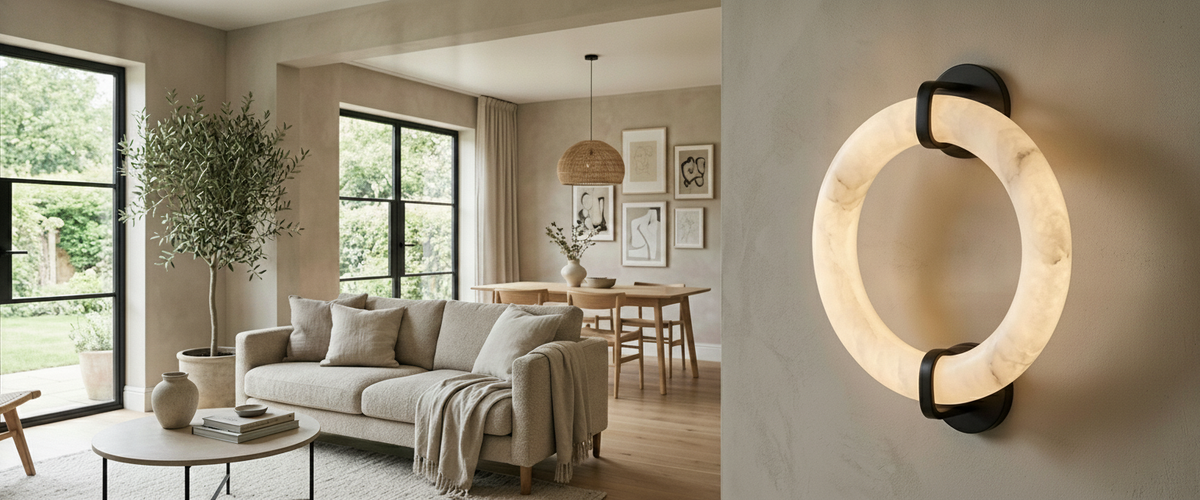

Plug an old dimmer into a room full of LED bulbs and you will hear about it within a week: a faint buzz at half brightness, a flicker that catches the corner of your eye, and a stubborn dead zone where the dial does nothing until the lights snap off. The fix is rarely the bulbs. It is the pairing. Dimmer switch LED lights only behave when the dimmer is built for low-wattage LED loads and the bulbs themselves are marked dimmable. Get both right and an alabaster pendant will fade from full daylight read-down to a candle-soft glow without a single hiccup.
This matters more with natural stone than with bare glass. Alabaster and onyx diffuse light through the material itself, so the way dimmer switch LED lights fade changes how the veining reads across the room. A clean dim curve makes the stone look alive at every level.

Key Takeaways
Match the dimmer to the load. Use a trailing-edge LED dimmer rated for low wattage, not an old resistive dimmer designed for halogen.
Check the bulb says dimmable. Non-dimmable lamps will flicker or buzz on any control.
Mind the minimum load. A few LED bulbs may draw too little for an older dimmer to read.
Warm dimming flatters stone. Bulbs that shift warmer as they dim suit alabaster and onyx best.
Use a qualified electrician for any mains wiring. The steps below explain the principle, not a licence to skip the professional.

What Dimmer Switch LED Lights Means and Who It Is Best For
A dimmer switch LED lights setup is a wall control that chops the waveform reaching dimmable bulbs, letting you set brightness anywhere between off and full. The phrase covers two parts that have to agree: the dimmer light switch on the wall and the driver inside each lamp. When they are designed for each other, the result is smooth and quiet. When they are not, you get the buzz and flicker that gives dimmer switch LED lights a bad name.
This is best for anyone who wants one fixture to do several jobs. A dining chandelier that reads bright for homework and low for a long dinner. A bedroom wall light that drops to a near-glow without changing bulbs. For natural-stone lighting in particular, dimmer switch LED lights are less about saving energy and more about mood: the same alabaster shade can feel crisp at noon and intimate at ten, and the control is what carries it between the two.
Key Materials, Finishes and Scale Decisions
Three things decide how dimmer switch LED lights look at low output: the stone, the bulb, and the dim technology behind the switch.
Alabaster is the softest performer at low brightness. Because light passes through the stone rather than bouncing off it, the warm glow stays even as you dim, and the veining holds its character. Onyx is more dramatic; its stronger banding can look almost backlit at full power and settles into a moody amber low down. Marble used as a shade reads denser, so you may want a slightly higher lumen bulb to keep it from going flat when dimmed hard.
For bulbs, look for warm-dim or dim-to-warm LEDs if you want that candlelit shift as brightness falls, the effect that flatters stone most. Standard dimmable lamps hold a fixed colour temperature and simply get dimmer, which is fine for task areas. Either way the bulb must be marked dimmable and its wattage logged, because the total load across the fixture has to sit inside your dimmer's stated range. If you want to read more on getting the warm tones right, our guide to choosing warm white LED bulbs for alabaster lighting walks through color temperature and bulb spec in detail. Where the lighting is concealed rather than housed in a shade, a dimmable run such as the Ecliptus 24V Dimmable LED Strip Light 15W gives you the same warm-down behaviour for coves and shelf washes, and confirms its dimmable rating on the spec rather than leaving it to chance.
Scale matters for the switch choice too. A single small wall light may draw so little power that a budget dimmer cannot register it and flickers at the bottom of the dial. A large chandelier with several lamps gives the control a healthier load to work with, which is why dimmer switch LED lights behave best on a fuller circuit. You can browse fixture types across the lighting collection to see which forms suit a dimmed scheme before you settle on bulb count.
Where to Place Dimmer Switch LED Lights for the Strongest Visual Impact
Dimmer switch LED lights earn their keep in rooms that change use through the day. Here is where they pay off.
Dining room
The classic case. An alabaster chandelier over the table wants to be bright while you serve and low while you linger. Set the dimmer so full brightness clears plates and the lower third of the dial gives a warm pool that keeps faces lit without glare on the stone.
Bedroom
Wall lights flanking the bed are the strongest argument for dimmer switch LED lights. At full they read for late-night pages; brought right down they hold just enough glow to cross the room. With dim-to-warm bulbs the alabaster turns honey-coloured at the bottom, which is exactly the wind-down cue you want.
Living room
Mix a dimmed floor or table lamp into a layered scheme so you are never relying on one bright ceiling source. A stone table lamp at low output becomes ambient fill against a TV; turned up, it carries reading.
Hallway and stairs
A dimmed wall light here is practical safety lighting that does not blast you at 2am. Set a comfortable low default and you rarely need to touch it.
Across all of these, the goal is the same: let the stone glow rather than glare. If you are choosing the fixtures around this idea, the alabaster lighting range shows how the material behaves when light is meant to pass through it.
How to Wire and Fit a Dimmer Switch
Before anything else: any work on mains wiring should be done or signed off by a qualified electrician. In the UK this falls under the wiring regulations, and the advice from Electrical Safety First is to use a registered professional for fixed wiring. The outline below is so you understand what is happening when you set up dimmer switch LED lights, not a green light to do it yourself.
In principle, fitting a dimmer replaces a standard wall switch in the same back box. The steps run roughly like this:
Isolate the circuit at the consumer unit and confirm it is dead with a tester.
Remove the existing switch faceplate and note which wires sit in which terminal. Most domestic switches have a live in, a switched live out, and on two-way arrangements a pair of travellers.
Transfer those wires into the matching terminals on the dimmer module, following the maker's diagram. A two-way dimmer wires much like a standard two-way control such as the 10AX 1 Gang 2-Way Switch, with the traveller terminals used when a second switch controls the same light.
Check the dimmer's minimum and maximum LED load against the total wattage of the bulbs on the circuit.
Seat the module in the back box, fix the faceplate, restore power, and test the full sweep of the dial for flicker or buzz.
If the lights flicker at the bottom or hum at half, the usual culprits are a non-dimmable bulb in the run, a load below the dimmer's minimum, or a trailing-edge dimmer mismatched to the driver. Swapping to a confirmed dimmable warm-dim bulb fixes most cases.
Budget, Quality and Delivery Considerations
What you pay across a dimmed stone-lighting scheme depends on the fixture, not the switch. Material, scale, the complexity of the carving, the engineering inside, and installation all move the figure. A single carved alabaster wall light sits in a very different place from a multi-arm chandelier cut from matched stone. Rather than quote a band that would not survive contact with a real project, we would rather look at your fixtures and give you a tailored quote.
On the switch side, the saving worth making is buying the right LED dimmer once rather than a cheap one twice. A quality trailing-edge dimmer rated for low loads costs little against the fixture and removes the flicker problem at the source. Confirm the dimmer's load range covers your bulbs before you buy, and keep a note of the bulb spec for when lamps need replacing years later. Done right, dimmer switch LED lights stay quiet and smooth for the life of the fixture.
How Niori Can Help With Lighting Projects
Niori is an alabaster and natural-stone lighting brand: pendants, chandeliers, wall lights, table lamps, and floor lamps cut from alabaster, onyx, and marble, often with brass detailing. Because we know how each stone reads when it is lit from within, we can advise on which fixtures hold up best on a dimmer and which warm-dim bulbs flatter the veining. We ship worldwide and can talk a designer or homeowner through fixture choice, bulb spec, and the dimmer switch LED lights that suit a layered scheme. Start at the Niori homepage to see the range, then send us the room and we will help match the stone to the way you light it.