

Two alabaster wall lights can look identical in a photograph and behave completely differently once they are switched on. One glows evenly, a warm honey wash across the stone. The other shows a hard bright patch where the bulb sits and goes muddy towards the edges. The difference was decided long before either piece reached a wall, often before the stone was even cut. If you are shopping for an alabaster modern wall light, the smartest thing you can do is understand the decisions a maker takes upstream, because those decisions set the ceiling on how the finished sconce performs.
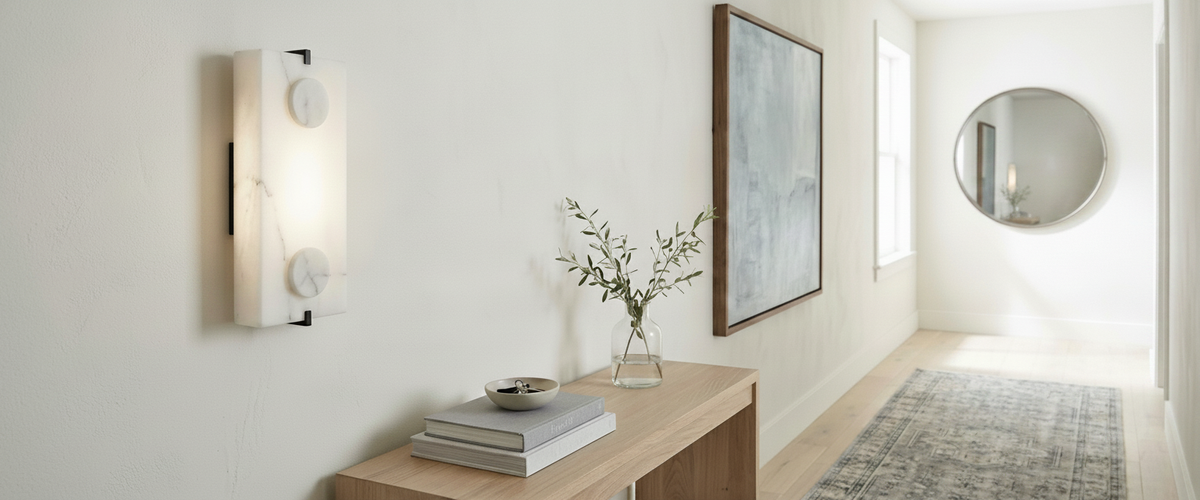
An evenly lit alabaster sconce, the result of careful slab selection and tuned carving.
Alabaster is a soft, translucent stone, usually gypsum, that has been carved for light and ornament since antiquity. The British Museum holds Assyrian alabaster panels thousands of years old, which tells you something about how long people have valued this material for the way it handles light. The modern version is the same stone, engineered for LED, and it is exactly that pairing that gives an alabaster modern wall light its quiet appeal.

Key Takeaways
Slab selection sets the maximum quality of the glow; nothing downstream fully fixes a poor slab.
Carving thickness is a trade-off between strength and translucency, and good makers tune it deliberately.
The wiring, mounting plate and heat management are the parts buyers never see and the parts that fail first when done cheaply.
Finishing choices (edge treatment, backplate metal, dimming) move the price more than most people expect.
Asking a few sharp questions quickly separates a serious workshop from a reseller who only assembles parts.

What a Maker Decides Before Any Stone Is Cut
Before a single cut, a maker is choosing the role the piece will play. A flush, rectangular alabaster contemporary wall light for a hallway has different demands from a bowl-shaped uplighter flanking a fireplace. The bulb position, the wall distance, the direction the light throws, all of that is set at the design stage. Get it wrong and you spend the rest of the build compensating, and no alabaster modern wall light recovers fully from a bad start.
This is also where the maker decides how forgiving the design needs to be. Natural stone is not uniform. A design that depends on a perfect, flawless panel will reject most of the quarry. A design that works with the stone's natural movement is both more honest and more achievable. The pieces in our alabaster lighting range are drawn so the veining reads as character rather than a defect to hide.
Why Slab Selection Sets the Ceiling on How It Glows
Slab selection is the quiet, expensive part nobody photographs. Alabaster varies block to block in density, mineral content and how its veins run. Hold one slab to a lamp and the light spreads softly; hold the next and a dark seam blocks it like a curtain. A maker who hand-selects backlit-grade stone for an alabaster modern wall light is paying for the privilege of rejecting a lot of material. If you want a deeper look at how the raw material behaves, our guide on choosing alabaster lighting for your home walks through grade and veining in more detail.
Vein direction decides how cleanly light travels through the stone.
Vein direction matters more than colour. When veins run roughly parallel to the lit face, light travels through cleanly. When they cut across the panel at depth, you get banding and cold patches that no bulb choice will rescue. The mineral structure of the stone decides most of the outcome, and a careful maker selects accordingly.
This is why two listings at the same size can sit at very different prices. One maker uses whatever slab the block yielded. Another cuts three panels and keeps one. With a good alabaster modern wall light, you are paying for the two that went in the offcut bin.
Carving Thickness: The Balance Between Strength and Translucency
Thickness is where craft becomes visible. Carve the alabaster too thick and it stays dim and heavy, the glow muted no matter how bright the LED behind it. Carve it too thin and it glows beautifully until the day it cracks, because alabaster is soft and unforgiving of stress points around fixings and mounting holes.
Good makers vary thickness across a single panel. Slightly thicker where the piece bolts to the wall, thinner across the broad lit face. On an alabaster modern wall light that wants an even, lantern-like wash, the maker may also relieve the back of the stone (carving a shallow recess) so light passes through a thinner section while the visible front keeps its solidity. Where you want that diffused, edge-to-edge softness rather than a hard downward beam, a frosted-glass fitting such as the Zira 2 Light Frosted Glass Wall Light follows a similar design logic, spreading the source instead of concentrating it. None of this shows in a thumbnail. All of it shows the moment the light is on.
A piece roughly the weight of a couple of bricks (around 2 to 3 kg) needs a mounting plate engineered for that load. Stone is heavier than the glass it often replaces, and that weight has to be carried safely for years.
Wiring, Mounting and Heat: The Parts Buyers Never See
Here is the unglamorous truth. The most common failure in a cheap alabaster wall sconce is not the stone. It is heat. LEDs run cool compared with old halogens, but they are not cold, and trapped heat inside a closed stone cavity shortens driver life and can, over time, discolour adhesives and yellow the stone from the inside.
A serious maker plans the cavity of an alabaster modern wall light for airflow or uses a low-output, well-driven LED matched to the enclosure. They choose a driver that fits the back box rather than forcing the installer to bury it in the wall. They use heat-stable fixings and bonding. We have had clients send us photographs of a previous fitting where the adhesive had cooked to brown along the top edge, a glow that turned grubby in under two years. That is almost always a heat-management failure, not bad stone.
One firm rule, whatever you buy: a hardwired stone sconce should be installed by a qualified electrician. These fittings are heavier and less tolerant of rough handling than the average wall light, and the mounting needs to be right the first time.
Bulbs and Dimming for an Even Glow
Colour temperature: warm white around 2700K flatters the honey tones of alabaster. In a bathroom, where grooming light needs to read true, a cooler integrated fitting such as the Sisley Large Bathroom LED Wall Light at 4000K is built deliberately crisper than you would ever want over alabaster.
Dimming: insist on a dimmable driver. An alabaster modern wall light looks its best at lower levels, where the stone reads as lit rather than glaring.
Bulb position: the light source should sit far enough from the stone face to spread, not press a bright hot spot against it.
Finishing Choices That Change the Final Price
Finishing is where two similar fittings part ways on cost. A hand-honed edge, softened and sealed, takes far longer than a quick machine bevel. Backplate metal moves the price too; solid brass and bronze cost more than plated steel and age differently. A polished chrome backplate suits a clean, modern bathroom; aged brass leans transitional or traditional and warms the stone further. On an alabaster modern wall light, these details are the slow, hand-finished work that the price reflects.
Sealing matters more than buyers realise. Alabaster is slightly porous and water-sensitive, so an alabaster bathroom wall light needs appropriate sealing and the right ingress rating for its zone. The Natural Stone Institute publishes guidance on sealing and cleaning soft stones, and the practical takeaway is to keep the stone away from standing water and harsh cleaners. A damp cloth, no solvents.
Because all of this varies, we do not quote a flat price for these fittings. Budget for an alabaster modern wall light depends on slab grade, scale, carving complexity, the metalwork, the driver and dimming, sealing and the finishing time. The honest answer is to ask for a tailored quote against the specific piece and finish, rather than trusting a round number.
Choosing the Right Alabaster Wall Light, Room by Room
Match the form to the job. In a hallway, a slim flush alabaster modern wall light gives a calm, even glow that does not eat the corridor. Flanking a bed, a pair of small sconces at reading height (roughly 1.5 m to the centre) creates symmetry and soft pools either side. In a living room, a bowl uplighter washes the wall and lifts the whole space at low output.
For an alabaster transitional wall light, look to aged brass detailing and a softly squared form that bridges classic and modern rooms. For a strictly contemporary scheme, choose clean geometry and a minimal backplate; this is the most pared-back face of the alabaster modern wall light. Alabaster sconce lighting works equally well as a matched pair or a single statement piece. You can compare forms across the wider lighting range, then narrow to the stone pieces that suit the room.
Questions That Separate a Serious Maker From a Quick Seller
Ask these before you buy an alabaster modern wall light, and listen for specific answers:
Is the alabaster hand-selected for backlighting, and how much is rejected? A vague answer means they buy in panels.
What is the carving thickness across the lit face? A real maker can tell you, and why it varies.
How is heat managed inside the cavity, and what driver is used? This predicts how the piece ages.
Is the driver dimmable, and at what colour temperature is the fitting designed to glow?
How is the stone sealed, and what is the ingress rating for a bathroom version?
What metal is the backplate, and is it solid or plated?
An assembler who buys generic stone panels and bolts on an off-the-shelf lamp will struggle with most of these. A workshop that cuts, carves and wires its own pieces will answer them without hesitation. At Niori, alabaster and natural stone is the whole point of the catalogue rather than one line among many, which is why we would rather talk about vein direction and driver choice than push a quick sale on an alabaster modern wall light.