
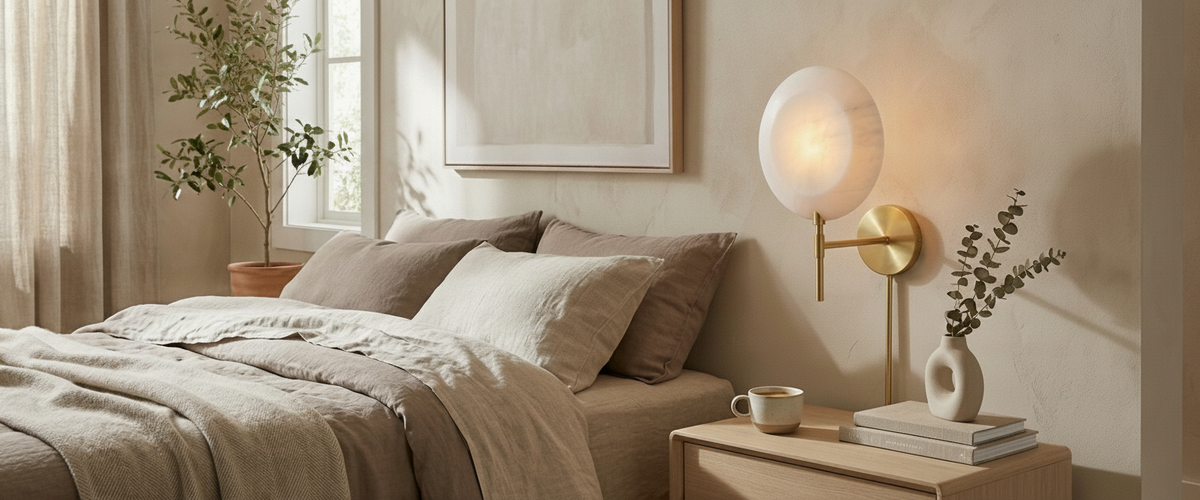

A bedside table lamp is a quiet thief. It takes the surface you wanted for a book, a glass of water, and your phone, then leaves a cable trailing down the back of the nightstand. Wall lights for bedroom use solve that in one move: they lift the fitting off the table, free up the surface, and put a soft pool of light exactly where you read. For floating beds, narrow rooms, and headboards pushed against an awkward wall, wall lights for bedroom layouts are usually the smarter call.
The catch is that a wall light only works if it is hung at the right height, spaced sensibly, and switched so one person can read while the other sleeps. Get those three things right and the room feels considered. Get them wrong and you are squinting past glare every night.

Key Takeaways
Height matters most: aim the centre of the light source roughly 24 to 30 inches (60 to 76 cm) above the mattress top so light falls on the page, not your eyes.
Spacing: keep sconces clear of the headboard, usually 8 to 12 inches (20 to 30 cm) outside each shoulder line.
Switching: each side wants its own switch or dimmer so partners do not wake each other.
Fitting type: swing-arm for active readers, fixed for ambience and a cleaner wall.
Finish: alabaster and natural stone give a warm, diffused glow that suits wall lights for bedroom use far better than a bare bulb.

Why Bedside Wall Lights Beat Lamps for Cramped or Floating Beds
In a small bedroom, the nightstand is rarely big enough for both a lamp and the things you actually use. Bedroom wall lights free that surface entirely. We shipped a pair of alabaster sconces to a client with a low platform bed and no real bedside tables to speak of; the wall fittings did the whole job, and the floor stayed clear underneath for cleaning and storage. This is the case where wall lights for bedroom setups earn their keep.
Floating beds, where the headboard sits away from the wall or the bed almost divides the room, are the other strong case. A lamp needs something to stand on. Wall lights for bedroom plans need only a wall, and they keep sightlines low and uncluttered. That said, wall fittings ask for a decision before installation rather than after, because moving a wired sconce is far more work than nudging a lamp. Measure first. If you are still weighing fittings room by room, our guide to choosing wall lights for every room covers how scale and placement shift between spaces.
The Height That Puts Light Where You Read, Not in Your Eyes
This is where most bedroom wall lighting goes wrong. People hang the sconce too high, copying the height they would use beside a sofa, and end up with light spilling across the wall instead of onto the book. Sat up against the headboard, your eyes sit around 24 to 36 inches (60 to 90 cm) above the mattress. You want the light source a touch below or level with eye height so the glow lands on the page.
As a working rule, set the centre of the fitting about 24 to 30 inches (60 to 76 cm) above the top of the mattress, then adjust for your headboard height and how upright you sit. Taller headboards push the number up. With an alabaster shade, you have more latitude here, because the stone diffuses the source and softens any glare. This is why good wall lights for bedroom reading rely on diffusion. A bare bulb at the same height would be harsh; alabaster turns it into a gentle wash. The Illuminating Engineering Society notes that reading needs adequate task light without glare, and diffusion is the simplest way to get both (ies.org).
Spacing Sconces to a Bed Without Crowding the Headboard
Symmetry reads as calm, so most bedrooms want a matched pair of wall lights for bedroom balance, one each side. Position each sconce 8 to 12 inches (20 to 30 cm) beyond the edge of the headboard or the sleeper's shoulder line. Too close and the fittings crowd the headboard and cast light behind you rather than onto the page; too far and you reach awkwardly for the switch.
For a king bed, that usually puts the pair somewhere around 5 to 6 feet (1.5 to 1.8 m) apart, centre to centre, but let the bed and headboard set the spacing rather than a fixed number. Hold the fitting against the wall, or tape a paper template at the proposed height, and sit on the bed to check. If you share with a partner, do this twice, once for each side, because shoulder lines and reading habits differ.
Swing-Arm Versus Fixed: Matching the Fitting to How You Read
How you read decides the fitting. A swing-arm option among wall lights for bedroom reading has an articulated arm you can pull toward the book and push back when you are done. It suits serious bedtime readers and anyone who wants to aim light precisely without lighting the whole wall. The trade-off is a busier object on the wall and a visible joint.
A fixed sconce sits flush and quiet. It is the better choice when you want the light as part of a calm composition, especially with a sculptural alabaster or onyx body where the form is the point. Fixed fittings throw a softer, broader pool, which is lovely for ambience and fine for light reading, less ideal if you read dense text late into the night. Where the wall needs a single discreet glow that doubles as a quiet decorative object, a compact piece such as Tilling 1 Light Wall Light reads more as part of the composition than a task fitting. Many of our buyers settle on fixed alabaster wall lights for bedroom corners for the look and accept a slightly more general light, then add a small clip light or book light for the occasional marathon read. You can compare both styles across the lighting collection to see how arm and body change the character of a room.
Switching and Dimming So One Partner Isn't Woken by the Other
The single most overlooked detail in bedroom wall sconce lighting is independent control. Each side needs its own switch, ideally a dimmer, so one person can read at a low warm level while the other side stays dark. Wiring this is a job for a qualified electrician; ask for separate switched circuits or individually switched fittings at the planning stage, because retrofitting is fiddly. Good wall lights for bedroom switching pays off every night.
For the bulb, choose a warm colour temperature, around 2200K to 2700K, which keeps the room restful and flatters the natural cream and amber tones in alabaster. Make sure your bulbs and your dimmer are compatible; mismatched LED and dimmer pairings are the usual cause of flicker and buzz. A wall-mounted toggle or a discreet cord switch on the fitting itself both work, but cord switches let you turn the light off without leaning out of bed, which partners tend to appreciate.
Backdrops and Finishes That Suit a Calm Bedroom Wall
The wall behind the bed is the backdrop for the light, so the two should agree. Soft, muted colours let an alabaster glow read as warmth rather than fighting it. Light blue bedroom walls are a good example; the cool wall and the warm stone balance each other, and the effect is restful without being flat. Deep tones such as charcoal or ink behave differently, soaking up light, so you may want a slightly brighter source or a second layer of lighting to keep the room from feeling dim.
For materials, alabaster and natural stone are doing real work in a bedroom rather than just looking the part. The translucency means the fitting glows from within when lit and reads as a pale sculptural object when off, which is why so many wall lights for bedroom schemes lean on stone. Where the room needs a soft diffused glow rather than a hard downlight, a frosted-glass fitting such as Zira 2 Light Frosted Glass Wall Light sits closer to the right design language, while a crystal piece like Divine 1 Light Crystal Wall Light adds a little more sparkle against a muted wall. Each stone piece carries its own veining, so a pair will be close but never identical, which most people find adds character rather than detracts. Brass detailing warms the palette; chrome and polished nickel keep it crisper. Browse the alabaster lighting range to see how stone changes the quality of light against different wall colours. Niori works almost entirely in alabaster and natural stone for exactly this reason: it gives a softer, more forgiving light than glass or metal alone.
How to Install Wall Lights in the Bedroom: A Quick Checklist
Mark the height: mattress top plus 24 to 30 inches (60 to 76 cm) to the centre of the fitting, adjusted for your headboard.
Set the spacing: 8 to 12 inches (20 to 30 cm) beyond each shoulder line, matched left and right.
Check sitting up: tape a template, sit on the bed, confirm the light falls on the page.
Plan the switching: independent dimmers per side, agreed before wiring.
Confirm the wall type: stone fittings have weight, so fixings must suit plasterboard, brick, or stud; tell your electrician the fitting weight in advance.
Use a qualified electrician: any mains wiring should be done to the relevant wiring regulations by a competent professional.
Fairy Lights and String Lights: A Softer Layer
Wall sconces handle the task light. If you want a gentler decorative layer, fairy lights and string lights add a low glow without much effort. To hang fairy lights on a bedroom wall, use removable adhesive clips or hooks every few inches so the cable does not sag, and keep the run away from anything that traps heat. For string lights, a slim wire run along a picture rail or the top edge of the headboard wall gives an even line; battery or low-voltage USB versions avoid extra wiring. Treat these as mood lighting around your wall lights for bedroom reading, not a replacement for proper reading light from those alabaster sconces.