
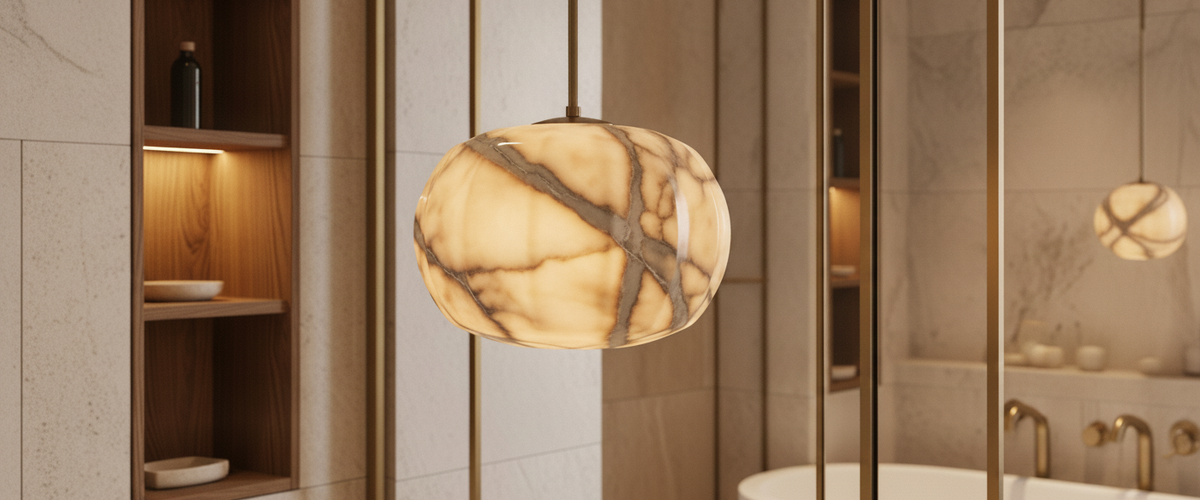

Hang a glass pendant over a dining table and you light the table. Hang an alabaster pendant light over the same table and you light the room around it, because the stone refuses to behave like a clear shade. Light has to push through several millimetres of mineral before it reaches anyone, and what arrives is softer, warmer, and far kinder to faces than a bare bulb behind glass. That single difference is why designers keep specifying an alabaster pendant light for the spots where people actually sit and eat.
The diffused glow of an alabaster pendant light flatters food, glassware, and the people around the table.
Before we get into placement and bulbs, here is the short version.
Light quality: an alabaster pendant light scatters light from inside the stone, so the glow looks lit-from-within rather than aimed.
Veining: the grey and amber streaks become part of the fixture's character and cast faint shadow patterns on the ceiling.
Placement: a single pendant suits a round table; a run of three suits a long island or rectangular table.
Bulbs: aim for 2700K to 3000K and a dimmer, or the warm core tips toward orange.
Ceiling height: a large contemporary alabaster pendant can crowd a low room; measure before you fall in love.

The Diffused Downwash: Why Alabaster Lights a Table Differently
Glass and acrylic transmit light. Alabaster diffuses it. The stone is faintly translucent, so a bulb sitting inside an alabaster bowl or disc spreads its output across the whole surface instead of pushing a hard beam straight down. You get a broad, even pool of light on the table and a gentle wash up onto the walls, rather than a tight circle and dark edges.
This matters most over a dining table, where people sit for hours and nobody wants the harsh top-down light you would find over a kitchen worktop. The diffused downwash from an alabaster pendant lighting setup flatters food, glassware, and the people around the table. We have shipped pendants to clients who previously lived under a bright glass fixture, and the most common feedback is that dinner suddenly feels longer and more relaxed. That is not magic; it is the stone taking the glare out.
Natural alabaster is a form of gypsum, prized since antiquity precisely because it lets light through; the British Museum holds carved alabaster vessels that show how long people have worked the stone for exactly this quality. You can read more about how an alabaster pendant light behaves across our alabaster lighting range. For a wider look at how alabaster fixtures shape a room, our guide to choosing alabaster lighting walks through the material in more detail.

Veining as a Feature, Not a Flaw
Every alabaster panel is cut from stone that formed over millennia, so no two pieces match. Expect cloudy grey passages, warm amber drifts, and the occasional darker vein running through the surface. Some buyers worry these marks are defects. They are not. They are the reason an alabaster pendant light looks alive when lit and inert when switched off.
Lit from within, the veins throw soft, candle-like patterns onto the ceiling and walls.
When the light is on, those veins do something glass never will: they throw soft, irregular patterns onto the ceiling and nearby walls. The effect is subtle, more like candlelight on plaster than a projected image, and it shifts depending on the bulb and the angle. If you want a perfectly uniform glow with no character, alabaster is the wrong material. If you want a fixture that reads as a piece of stone rather than a manufactured shade, the veining is the whole point.
One practical note: ask to see images of the actual piece where possible, because the veining genuinely varies. A heavily marbled alabaster pendant light reads bolder and warmer; a paler one reads quieter and more contemporary.
Single Pendant Over an Island Versus a Run of Three
The number of pendants changes the whole feel of the light, not just the brightness.
A single large alabaster pendant light centred over a round table or a compact island gives one generous pool of light and a strong focal point. It is the cleaner, calmer look. The risk is that a single fixture over a long surface leaves the ends dim, so this works best when the table is roughly as wide as it is long.
A run of three smaller pendants suits a long kitchen island or a rectangular dining table. The three pools overlap into a continuous band of light, so nobody sits in shadow at the far end. Visually it is busier and more rhythmic. Spacing matters: keep the pendants evenly divided along the surface, not crammed to the centre, and leave roughly equal gaps at each end. As a rough starting point, hang the bottom of each pendant about 30 to 36 inches (76 to 91 cm) above the surface, then adjust for the height of the people who will use the room.
A linear alabaster suspension light is a neat middle path. It gives the spread of three pendants in one continuous fixture, which keeps the ceiling simple while still lighting the whole length of an island. Where a long island needs even coverage without a cluster of separate fittings, a piece like the Zareon LED Large Linear Alabaster Suspension Light lights the full run from a single clean line. Browse the broader lighting collection if you want to compare a single alabaster pendant light against linear and stepped suspension pieces.
Warm Bulbs and Dimming: The Honey-Lit Core Without Going Orange
Alabaster already pushes light toward the warm end, because the amber in the stone tints whatever passes through it. Pair that with a very warm bulb and you can tip the whole thing into a sodium-street-lamp orange that nobody wants.
The sweet spot for most homes is 2700K to 3000K. At 2700K you get a cosy, candlelit warmth that suits dining and living rooms. At 3000K the light stays warm but reads a touch crisper, which helps in a kitchen where you also need to see what you are chopping. Below 2700K the orange cast starts to fight the stone. Above 3500K the light goes clinical and the alabaster loses its glow.
Colour rendering matters too. Look for a bulb with a CRI of 90 or above so the veining and your food both show true colour; the lighting industry treats high CRI as the benchmark for spaces where appearance counts, and the Illuminating Engineering Society publishes guidance on why. Fit a dimmer as standard. The ability to drop an alabaster light pendant down to a low, honeyed glow after dinner is half the reason to buy one. Check that the LED driver is genuinely dimmable and matched to your dimmer, or you will get flicker at the bottom of the range. If you are rewiring or adding a circuit, use a qualified electrician.
Where a Contemporary Alabaster Pendant Overwhelms a Low Ceiling
The most common buying mistake we see is scale. A large modern alabaster pendant light photographs beautifully in a double-height hallway, so people order the same piece for a room with an eight-foot (2.4 m) ceiling and then find it hangs at forehead level or dominates the space.
Two rules keep you safe. First, leave at least 7 feet (2.1 m) of clearance from the floor to the bottom of any pendant people walk under. Second, in a low-ceilinged room, choose a flatter disc or a slim linear form rather than a tall globe or a deep bowl, which eats vertical space. Where the ceiling is tight but you still want stone and brass, a more compact alabaster pendant light such as the Zareon LED Medium Stepped Alabaster Suspension Light gives the soft glow without the bulk of a deep globe.
Over a table you have more freedom, because nobody walks under it; there you can hang lower and let the fixture do its work. But in a hallway, a galley kitchen, or a snug, measure twice. An alabaster pendant light that overwhelms the room kills the calm that drew you to the stone in the first place.
Pairing the Pendant With the Surfaces It Has to Light
An alabaster pendant light does not work alone; it works against the surfaces around it. Warm light loves warm materials. Over an oak or walnut table the honeyed glow reads rich and intentional. Over a cool grey marble island the same light brings out the warmth in the stone and stops the room feeling clinical.
Be careful with very white, very cool surfaces. A bright white quartz worktop under a warm alabaster pendant light can look slightly yellow, which some people love and others do not. If your scheme is deliberately cool and crisp, lean toward 3000K rather than 2700K, or balance the room with cooler task lighting elsewhere so the pendant becomes the warm accent rather than the only light source.
Brass detailing on the fixture is worth a thought too. Brushed brass or soft gold picks up the amber in the stone and ties the alabaster pendant light to warm metals elsewhere in the room, which is why a piece like the Zareon LED Large Chevron Alabaster Suspension Light in Brushed Brass reads warmer over wood than a cooler metal would. A matt black or chrome fitting reads more contemporary and gives the warm stone a sharper frame.
Quick Buying Checklist
Measure ceiling height and confirm at least 7 feet (2.1 m) clearance under any walkway pendant.
Match the layout to the table: single pendant for round, a run of three or a linear suspension for long.
Specify 2700K to 3000K bulbs at CRI 90 or above.
Fit a compatible dimmer and confirm the LED driver is dimmable.
Choose the metal finish to suit your other warm or cool materials.
Ask to see the actual veining where the piece allows it.
Plan the surface underneath: warm woods and stones flatter the glow; very cool whites may read yellow.
Get those right and an alabaster pendant light earns its place not as a light fitting but as the thing that sets the mood every time you flick the switch. Niori works only in alabaster and natural stone, so the whole range is built around getting that soft, lit-from-within glow to land where you need it.