
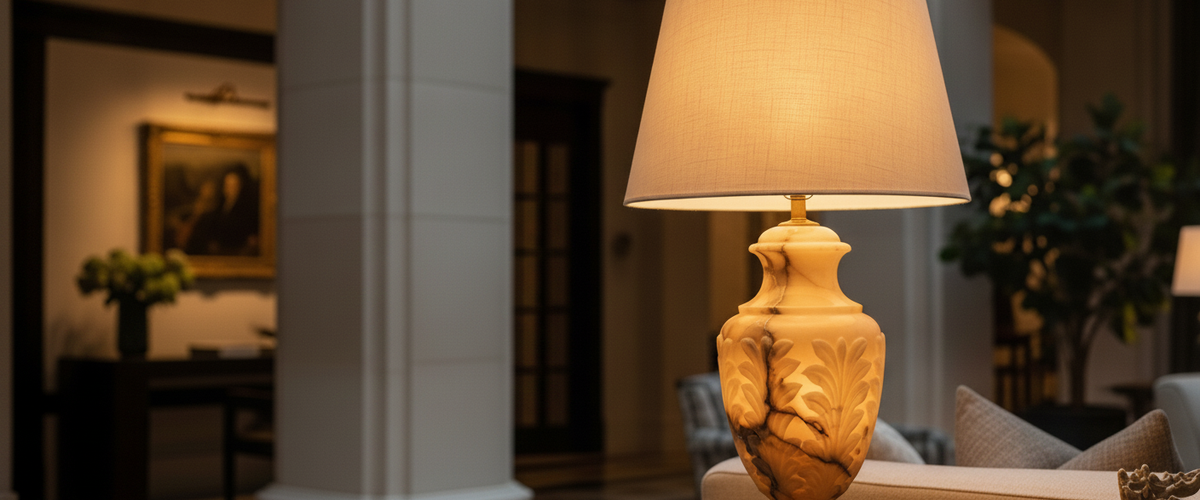

An antique alabaster table lamp does something a new one cannot quite fake: the stone has lived a little. Decades of handling, light minerals settling into the veining, a base that has warmed to a faintly honeyed tone. Drop one onto a clean modern console and it can either anchor the whole room or sit there looking like a relative nobody invited. The difference is almost always placement, scale and the bulb you put inside it.
We field this question often at the studio, usually from people who have inherited an antique alabaster table lamp or found one at a salvage fair and want it to work alongside furniture that is twenty years newer. The good news is that aged alabaster is forgiving. It just needs the right room and a bit of restraint around it.
An aged alabaster base reads warm against cool, modern surroundings.

Key Takeaways
Aged alabaster reads warmer than freshly carved stone, so an antique alabaster table lamp leans best against cool, contemporary palettes rather than fighting other antiques.
Scale matters more than style. Get the height and shade proportion right and the lamp settles; get it wrong and no amount of styling rescues it.
Use a warm, dimmable bulb in the 2200K to 2700K range to honor the softer tone old stone gives.
One antique base in a modern scheme works. Two competing antiques in the same sightline rarely do.
Check the wiring. Salvaged lamps almost always need rewiring by a qualified electrician before use.

How Aged Alabaster Reads Against Clean Contemporary Interiors
Freshly quarried alabaster glows with a bright, milky clarity. An older piece is different. Years of exposure tend to deepen the cream and pull out the natural mineral threads, so an antique alabaster table lamp throws a glow that feels closer to candlelight than to a modern fitting. That warmth is exactly why it sits so comfortably against the cooler grays, off-whites and pale oak you find in a lot of current interiors.
The contrast is the point. Set the antique alabaster table lamp on a crisp lacquered surface or a slab of pale marble and the soft, slightly imperfect stone reads as the quiet hero of the corner. Surround it with other heavy period pieces, though, and it disappears into the brown. Alabaster is a soft, translucent stone that has been carved and lit for centuries; the Victoria and Albert Museum holds plenty of historic examples that show how the material was prized precisely for the way it filters light rather than blocking it.
The same diffusion is visible in modern fittings, which gives you a useful gauge when judging an older lamp. Where a corner needs that translucent stone glow at floor height rather than on a table, a piece such as the Marmo 2 Light Alabaster Floor Lamp shows how the material behaves at scale, and the wider alabaster lighting collection is worth scanning before you commit. If you are still deciding which stone suits the room, our guide on alabaster vs marble lighting breaks down how each material handles light.
Scale and Shade Height: Choices That Change How the Piece Sits
Most placement failures with an antique alabaster table lamp are scale failures in disguise. The base might be a beautiful 14 inches (about 36 cm) of carved stone, but if the shade balloons too tall, the whole thing tips top-heavy and the stone gets lost under fabric.
A few rules we lean on:
Shade height should roughly match or slightly undercut the base height. A squat, broad shade lets the alabaster carry the proportion.
Total lamp height on a side table usually wants to land so the bottom of the shade sits near eye level when you are seated, which spares you a glare-filled bulb.
On a console behind a sofa, a taller silhouette is fine because you read it standing. Where you genuinely want height and presence rather than a stone glow, a tall-shade lamp such as the Louviers Table Lamp with Tall Empire Shade shows the proportion that works standing, against which a squat alabaster base reads very differently.
Mind the diameter. A wide antique base on a narrow modern console looks marooned. Give the stone a surface it can own.
If your inherited antique alabaster table lamp feels small for a room, do not stretch it with an oversized shade. Pair it with a second light source instead and let it work as accent rather than primary.
Match the shade height to the base so the carved stone keeps its proportion.
Room by Room: Where the Antique Glow Lands and Where It Clashes
Living room. This is the natural home. An aged alabaster table lamp on a side table next to a contemporary armchair gives that low, warm pool of light a room needs for the evening. Keep the surroundings restrained and the lamp does the heavy lifting.
Bedroom. A matched pair on bedside tables is the classic move, though a true antique alabaster table lamp rarely comes in pairs. If you only have one, balance the other side with a different but tonally similar light rather than forcing a mismatched twin.
Entrance hall. A single lamp on a console makes a strong first impression and the soft glow is welcoming. Just check the base is heavy enough not to be knocked in a busy thoroughfare.
Home office or study. Lovely as ambient light, but alabaster diffuses rather than focuses, so it will not give you a task beam. Where you need a directional reading light alongside the soft glow, an adjustable fitting like the Notte Single Spotlight with Switch covers the task beam the stone cannot, and its antique brass finish keeps the tones in conversation.
Where it clashes. Bright, high-contrast kitchens with cool LED downlights tend to flatten the warmth out of old stone. So do rooms already crowded with darker antiques, where the antique alabaster table lamp simply blends in and loses its quiet authority.
Warm Bulbs and Dimming That Honor Old Stone's Softer Tone
The bulb is where people undo all their careful placement. Old alabaster wants warmth. Drop a cool white LED inside an antique alabaster table lamp and the glow turns slightly clinical, killing the honeyed quality that made you want the lamp in the first place.
Aim for a color temperature around 2200K to 2700K. That sits in the warm-white-to-amber range and flatters the natural veining instead of bleaching it. Lower color temperatures are simply warmer in tone; the guidance on light bulbs from ENERGY STAR is a clear primer on what those Kelvin numbers actually mean if the labels confuse you.
Pair the bulb with a dimmer. Alabaster looks its best when you can drop it low in the evening, where the stone seems to hold the light rather than emit it. Make sure your bulb and dimmer are compatible; a lot of flicker complaints come from a non-dimmable LED stuck on a trailing-edge dimmer. And keep the wattage modest. The thinner an antique alabaster wall is in places, the more an over-bright bulb will show hot spots through the stone.
Mixing One Antique Base Into a Modern Scheme Without It Looking Lost
The trick to making a vintage alabaster table lamp work in a current room is to let it be the only antique in the conversation. Surround it with clean lines and it reads as a deliberate, collected choice. Pile up the period furniture and it becomes background.
A few moves that consistently work:
Repeat the metal. If the lamp has aged brass fittings, echo that with a brass tray, frame or hardware nearby so the old base feels intentional.
Give it negative space. A modern alabaster table lamp or a sculptural new piece thrives on a busy shelf; an antique wants air around it.
Keep the shade quiet. A plain linen or parchment shade in a soft cream lets the stone speak. Patterned shades tend to date the whole arrangement.
Mix old and new across materials, not within the lamp. The stone is your texture; let the surfaces around it stay smooth.
For buyers weighing an antique alabaster table lamp against a contemporary alternative, it helps to see both worlds side by side. Our wider lighting range covers pendants, wall lights, floor and table lamps, which makes it easier to judge whether you want the patina of an old piece or the crispness of something new, including cordless alabaster table lamp options that suit spaces with no nearby socket.
Placement Mistakes We See With Inherited and Salvaged Lamps
Most problems with an antique alabaster table lamp and other salvaged lamps come down to a handful of repeat offenders.
Skipping the rewire. Old cloth-covered flex and worn plugs are a genuine fire risk. Have any salvaged lamp checked and rewired by a qualified electrician before it goes anywhere near a socket.
Cleaning it like glass. Alabaster is porous and water-sensitive. Never soak it or use household sprays. A dry, soft cloth for dust and a barely damp cloth for the occasional mark is plenty.
Standing it in a wet zone. Bathrooms, conservatories and window sills that catch condensation will mark the stone over time.
Lighting it too hot. An oversized bulb makes thin sections glow unevenly and adds heat the old stone does not need.
Burying it in clutter. A beautiful aged base behind a stack of books and a phone charger is wasted. Clear the surface and let the lamp register.
One client came to us with a single salvaged antique alabaster table lamp they loved but could not make sit right in a pale, contemporary sitting room in the country. The fix was small: a lower-wattage warm bulb, a plain cream shade cut shorter than the original, and clearing the side table down to just the lamp and a single small object. Nothing structural changed. It simply stopped competing with everything around it and started doing the one thing aged alabaster does so well, which is glow.
A Quick Buyer's Checklist
Check the stone for cracks, repairs and stable veining before you buy.
Assume your antique alabaster table lamp needs rewiring and budget for a qualified electrician.
Match a shade in height to the base, in a quiet cream linen or parchment.
Fit a warm, dimmable bulb around 2200K to 2700K at modest wattage.
Place it where it is the only antique in the sightline, with space to breathe.
Keep it dry, dust it gently, and never use chemical sprays on the stone.
Niori specializes in alabaster and natural-stone lighting, so we spend our days watching how this material behaves under different bulbs, in different rooms, at different times of day. An antique alabaster table lamp carries history a new fitting cannot, but the principles are the same: respect the scale, warm the light, and give the stone room to be seen. What you pay for an antique alabaster table lamp depends on condition, rarity and the rewiring it needs, so it is worth getting a proper assessment rather than guessing.