
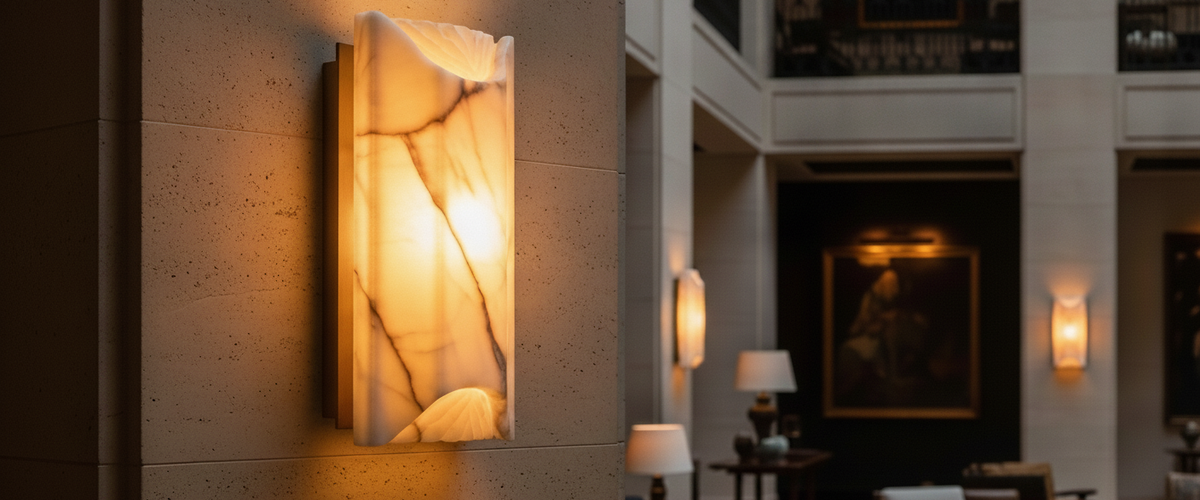

Switched off, an alabaster wall sconce reads like a pale stone panel; pleasant enough, easy to walk past. Switch it on and the stone turns into a light source you can stand next to without squinting. That shift is the whole point of alabaster wall sconce lighting, and it is the reason these fixtures behave so differently from a frosted glass or fabric shade. The stone is the diffuser. Light moves through it, picks up the veining, and arrives in the room already softened.
Most buyers shop for sconces by looking at the switched-off photo. That is the wrong reference. What matters is how a piece of alabaster wall sconce lighting performs lit, on a dimmer, in a real wall at eye height.
Lit, the stone becomes the diffuser, picking up amber and honey veining.

Quick Answer: What to Check Before You Buy
Translucency over colour: the glow depends on how thinly the stone is cut and how even the veining runs, not just the shade name.
Style matched to wall: modern slab sconces suit clean plaster; traditional shapes suit panelled or period walls.
Wiring reality: most wall sconces need a junction box behind the plaster, so plan the electrics before you fall for the design.
Bulb and dimmer: warm 2700K LED on a compatible dimmer flatters alabaster; cool white kills it.
One or a pair: a pair frames; a single accents. The wall decides.

Why Backlit Alabaster Looks Nothing Like It Does Switched Off
Alabaster is a soft, fine-grained form of gypsum, and it has been carved for lamps and window panels for centuries precisely because it lets light through without going transparent. The Metropolitan Museum of Art holds alabaster vessels and panels that show how long makers have used this quality. Hold a thin section to a bulb and you see the trick: the surface stays opaque enough to hide the source, yet glows from within.
That is what you are buying with alabaster wall sconce lighting. The light reaching the room has already passed through the panel, so it lands warm and diffused rather than sharp. Veins that look like faint grey lines in daylight become amber and honey threads once lit. No two pieces glow identically, which is the part machine-made shades cannot copy.
The practical takeaway: judge a piece of alabaster wall sconce lighting on its lit appearance. Ask to see it on a dimmer if you can, because alabaster shows its best range somewhere between thirty and seventy per cent brightness, not flat out.
Modern, Traditional and Contemporary Sconces, and the Walls They Suit
Style is not just taste here; it decides how the fixture sits against your architecture, and good alabaster wall sconce lighting works with the wall instead of fighting it.
An alabaster modern wall light tends toward clean geometry: a flat slab, a half-cylinder, a simple bar with the stone front and centre. These read well on smooth plaster, plain plasterboard, and the kind of pared-back rooms you see in new builds across the UK. The stone does the decorating, so the bracket stays minimal. Where you want the same minimal geometry but a brighter, more architectural line of light, a fixture such as the Flux LED Linear Wall Light shows how far a slim white profile can go before the stone becomes the design language instead.
The same stone reads very differently across modern slabs and traditional brackets.
An alabaster traditional wall light leans on shape and metalwork: a shaped backplate, a candle-style arm, brass or bronze detailing that frames the stone. These earn their place on panelled walls, in period hallways, and beside fireplaces where a flat slab would look out of step.
An alabaster contemporary wall light sits between the two; it borrows a recognisable form but strips the ornament back. An alabaster transitional wall light does the same job for rooms that mix old and new, which describes a large share of renovated homes. If your hallway has original cornicing but a modern kitchen beyond it, transitional alabaster wall sconce lighting is usually the safer call than committing hard to either end.
You can compare the shapes side by side in the alabaster lighting range to see how the same material reads across modern and traditional brackets. For a deeper look at how to mix these styles room by room, our guide to alabaster lighting walks through the full scheme.
Stone Thickness and Translucency Decide the Glow
This is the spec that separates alabaster wall sconce lighting that looks lit from a sconce that looks lumpy. Two factors matter.
Thickness. Cut the stone too thick and the light struggles through, leaving the panel dim and the source visible as a hot spot. Cut it too thin and it can look pale and washed out, and it becomes more fragile. Good makers settle on a section that glows evenly without showing the bulb behind it.
Vein consistency. Alabaster is natural, so banding varies block to block. Dense, even veining diffuses light beautifully. Heavy dark bands or fault lines can throw shadows or, worse, become weak points. A studio that hand-selects stone for its alabaster wall sconce lighting will reject the panels that backlight badly, which is part of what you pay for.
One lesson from the workshop: a panel that looks dramatic in daylight can disappoint when lit, because strong dark veins block the very light you want to pass through. The best lit pieces often look comparatively quiet switched off. If you only ever see a switched-off product shot, you are being shown the least important version of the piece.
Wiring, Junction Boxes and the Bits Most Buyers Skip
The design choice is the fun part. The wiring is where projects stall, and alabaster wall sconce lighting is no exception.
Most hardwired wall sconces connect to a junction box set into the wall, with the cable feeding through the backplate. On a new build or full renovation, you plan this before the plaster goes on. On an existing wall, it means chasing a cable in and making good afterwards, which is messier and worth budgeting for. In the UK, wall-light circuits and any work in a bathroom zone fall under wiring regulations, so this is firmly a job for a qualified electrician, not a weekend task.
Three things to sort before you order:
Box position and height. Sconces usually sit somewhere between 5 and 6 feet (1.5 to 1.8 m) from the floor, but flanking a mirror or a bed changes that. Decide the centre line before the electrician fixes the box.
Switching. Will the sconces run off the main switch, a separate dimmer, or a smart relay? Decide early so the right cable goes in.
Bathroom rating. An alabaster bathroom wall light must be specified for its zone. Near a basin or shower you need an appropriate IP rating and correct placement, and alabaster's porosity means steam and splashes deserve respect. Where the wet zone rules out stone altogether, a sealed IP-rated fitting such as the Morvah 1 Light Wall Light in White is the safer choice for the splash-prone positions while alabaster stays in the drier parts of the room. Confirm suitability before committing.
If you are still mapping which rooms get wall lights versus pendants or table lamps, browsing the wider lighting collection helps you plan the scheme as a whole rather than buying piecemeal.
Where a Pair Earns Its Place, and Where One Is Plenty
Symmetry is the quiet superpower of alabaster wall sconce lighting. A matched pair frames whatever sits between them: a fireplace, a mirror, a headboard, a doorway. In a bedroom, a pair flanking the bed replaces bulky bedside lamps and frees the nightstand, which clients with smaller city flats appreciate.
A single sconce works as an accent rather than a frame. It suits a stair landing, the turn of a hallway, or a stretch of wall beside a console where a pair would crowd the space. The rule of thumb: if the wall has a clear centre (a mirror, a bed, a chimney breast) reach for two. If it is an in-between zone you want to mark gently, one piece of alabaster wall sconce lighting is enough.
For long corridors, a run of identical sconces at even spacing gives rhythm and pools of warm light without the glare of downlights overhead. That is one of the most underused tricks in UK hallways, where strip downlights still dominate.
Quality Markers That Justify the Price Jump
An alabaster wall light can span a wide price range, and the cost of alabaster wall sconce lighting depends on the material grade, the size, the metalwork, the engineering and the finishing rather than any single number. Here is what you are actually paying for at the top end.
Hand-selected stone. Panels chosen for even backlighting, not just surface looks. This is invisible in a daylight photo and obvious the moment you switch on.
Solid metalwork. Brass or bronze backplates and arms that feel weighted, with a finish that wears gracefully rather than flaking.
Considered light source. Fittings designed around warm LED, positioned so the bulb does not burn a bright spot through the stone.
Honest sealing. Quality alabaster is finished to resist dust and the odd splash without looking plasticky, which matters most in bathrooms and kitchens.
Repairability. Pieces built so a bulb or driver can be changed without destroying the fixture.
For a tailored figure on alabaster wall sconce lighting, ask for a quote against your exact size, finish and quantity rather than guessing from a range. The variables move the number more than the badge does.
Care That Keeps the Glow
Alabaster is softer than marble and dislikes water sitting on it. Dust with a dry, soft cloth. Skip household sprays and anything acidic, which can etch the surface. The Natural Stone Institute publishes general guidance on caring for soft, porous stone that is worth a read before you reach for a cleaner. In a bathroom, wipe away splashes promptly and make sure extraction is doing its job, because long-term steam is the real enemy.
Treated this way, alabaster wall sconce lighting holds its glow for years. The stone does not date, the metalwork patinates slowly, and your alabaster wall sconce lighting stays as soft on day one thousand as on day one.