
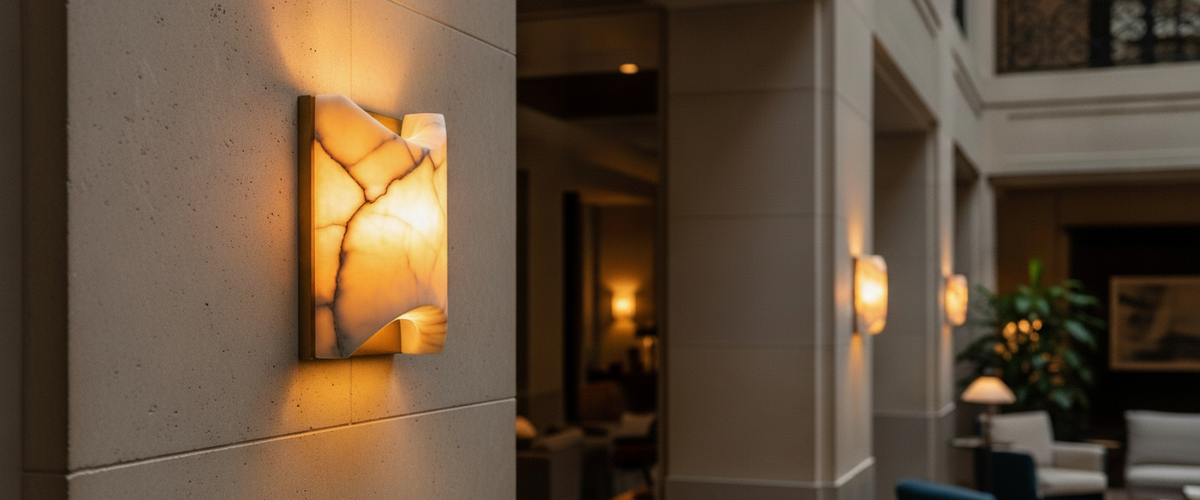

Switch on an alabaster wall light in a dim room and the wall stops being a wall. The stone catches the light from inside, the veining warms up, and a flat plaster surface turns into a soft panel of glow. Get the placement wrong, though, and that same alabaster wall light either hides in plain sight or throws a hard hotspot that flattens the stone entirely. Height, spacing, bulb choice, and the color behind it decide which version you end up with.
An alabaster sconce turns flat plaster into a soft panel of glow after dark.
An alabaster wall light that glows from within behaves differently to a downlight or a clear-glass fixture, so the usual rules of thumb only get you halfway. Below is how we think about it at Niori when buyers and designers ask where their alabaster sconces should actually go.

Key Takeaways
Mount most alabaster wall sconces with the center of the fixture around 60 to 66 inches (152 to 168 cm) from the floor, then adjust for ceiling height and use.
Space a run of sconces evenly, usually 6 to 8 feet (1.8 to 2.4 m) apart along a hallway or corridor.
Warm bulbs around 2400K to 2700K flatter natural veining; cool light makes alabaster look gray and dead.
Always pair an alabaster wall light with a dimmer so you can control glow at close range.
Pale stone against pale plaster reads quiet and architectural; against deep color it reads like a lantern.
For bathrooms, choose an IP-rated fixture and have a qualified electrician handle the install.

How a Glowing Slab of Stone Reshapes a Wall After Dark
Alabaster is mildly translucent. Light passes a short way into the stone before it scatters, which is why a good alabaster wall light looks lit from the core rather than from a bulb behind a shade. That internal glow is the whole point, and it changes how you place the fixture. A clear-glass sconce is a point of light you aim. An alabaster one is a soft surface you position so people see the glow, not the source.
This is also why thickness and cut matter. Thicker slabs and tighter veining hold more shadow and read richer; thinner, more even stone glows brighter and flatter. When you browse the alabaster lighting range, look at how the veining sits, because that pattern is what your alabaster wall light projects into the room every evening. If you want a primer on the material itself before you shop, our guide to alabaster lighting walks through how the stone is cut, lit, and finished.
Mounting Height and Spacing: The Calls That Change How Sconces Read
Standard wall-sconce height puts the center of the fixture roughly 60 to 66 inches (152 to 168 cm) above the finished floor. That lands the glow near eye level for most people standing, which is comfortable. A few adjustments earn their keep:
High ceilings: nudge sconces up a little so they relate to the wall's proportions, not just to a standing head.
Seated rooms: in a snug or reading corner, drop the fixture slightly so the glow falls toward a seated eye line.
Flanking a mirror or art: align the light source with the center of what it flanks, not with a generic number.
Spacing is where most runs go wrong. Along a hallway, set alabaster wall sconces 6 to 8 feet (1.8 to 2.4 m) apart so the pools of glow overlap gently and the corridor reads as a rhythm rather than a string of bright dots. Too close and the wall washes out; too far and you get bright patches separated by gloom. Walk the space at night before you commit the back boxes.
A matched pair of alabaster sconces flanking a mirror gives even, flattering light across the face.
Room by Room, From Hallway Flank to Bedside Flank
An alabaster modern wall light earns its place in almost every room, but the job changes with the space.
Entrance Halls and Corridors
This is where alabaster sconces do their best work. A pair flanking a console, or an evenly spaced run down a long hall, gives a low, welcoming glow that flatters faces and warms cold plaster. Keep each alabaster wall light at a consistent height and let the warm light do the greeting.
Living Rooms
Use wall lights to break a room out of a single overhead source. A symmetrical pair either side of a fireplace or a large piece of art frames the wall and adds the layered, low-level light that makes an evening room feel settled. An alabaster transitional wall light with a brass backplate sits comfortably between period and contemporary furniture, which is why designers reach for that style so often.
Bedrooms
An alabaster wall light beside the bed frees up the nightstand and puts soft light where you read. Mount each one so the lower edge of the glow sits around shoulder height when you are propped up, usually a touch lower than a hallway fixture. A dimmable warm bulb here is non-negotiable.
Bathrooms
An alabaster bathroom wall light flanking a mirror gives flattering, shadow-free light across the face, far kinder than a single ceiling downlight that drops shadows under the eyes. Bathrooms need the right ingress protection rating for the zone the fixture sits in, and the wiring should be handled by a qualified electrician. The IES has clear guidance on lighting for grooming tasks, where light at face level beats light from above (see the Illuminating Engineering Society). Where the alabaster look isn't viable in a wet zone, a softly diffused IP-rated piece such as Estalacta 1 Light Bathroom Wall Light stays closest to that glowing-panel language, while a slim single-lamp option like Dublin 1 Light Bathroom Wall Light works when you want warmth and brass without bulk beside a mirror. You can compare further options across the wider lighting collection.
Bulb Warmth and Dimming That Flatter Veining at Close Range
Color temperature makes or breaks alabaster. The stone has warm cream and amber tones in its grain, and a warm bulb brings those forward. Choose something in the 2400K to 2700K range. Push the bulb cooler, toward 3500K or 4000K, and the stone turns gray and chalky, which is the opposite of why you bought it.
Pay attention to color rendering too. A bulb with a CRI of 90 or above shows the subtle gradations in the stone honestly; cheap low-CRI lamps wash them out. On an alabaster wall light you stand close to, like a bedside or mirror fixture, that fidelity is the difference between rich and flat.
Always wire an alabaster wall light to a dimmer. Up close, full output can edge toward glare even through stone, and the magic of a glowing panel lives in the lower half of the dial. We had a client in a London townhouse who fitted a pair of beautiful alabaster wall lights but no dimmer, then complained the hall felt clinical at night. One compatible dimmer module later and the same fixtures looked exactly as they had hoped. Match the dimmer to the LED driver so you avoid flicker and buzz; the lamp or fixture spec will tell you what it wants.
Backdrop Choices: Pale Stone Against Pale Plaster Versus Deep Color
The wall behind the fixture is part of the design. Two approaches both work, and they say different things.
Pale alabaster against pale plaster or off-white paint reads quiet and architectural. The alabaster wall light becomes a soft luminous element that belongs to the wall, perfect for a calm hallway or a minimal bedroom where you want light without drama. An alabaster contemporary wall light handled this way disappears into the scheme until it is lit, then glows like part of the structure.
Pale stone against a deep color does the opposite. Set the same alabaster wall light on a charcoal, ink-blue, or forest-green wall and it reads like a lantern, the glow framed and amplified by the dark ground. This is the move for a dining room or a study where you want the wall light to be a focal point. An alabaster traditional wall light with an antique brass finish looks especially good against deep heritage paint.
Placement Mistakes That Leave Alabaster Sconces Glaring or Invisible
A few errors come up again and again. Worth checking your plan against them:
Mounting too high. Above 70 inches the glow floats out of reach and stops doing anything for the room or for faces. Bring it down to a human scale.
Spacing too tight on a run. Overlapping pools wash the wall into one flat band and lose the rhythm that makes a corridor feel considered.
Cool bulbs. The single fastest way to make warm alabaster look like cheap resin. Stay warm.
No dimmer. Full output close to the eye can glare even through stone, and you lose all the evening mood.
Ignoring symmetry. A pair flanking a mirror, bed, or fireplace must sit at matching heights and equal distances, or the eye reads the imbalance instantly.
Skipping IP ratings in wet zones. A bathroom sconce in the wrong zone is a safety problem, not a style choice. Match the rating and use a qualified electrician.
A Quick Buyer's Checklist
Confirm the room and the job: greeting glow, task light, or focal point.
Set the mounting height of each alabaster wall light to use, not just to a default number.
Plan spacing on a run before drilling; walk it at night.
Choose 2400K to 2700K bulbs with CRI 90 or above.
Wire to a compatible dimmer.
Decide pale-on-pale or pale-on-dark for the effect you want.
For bathrooms, check the IP rating and book a qualified electrician.
Budget for an alabaster wall light depends on the stone, the scale, the metalwork, and the finishing involved, so the honest answer is to request a tailored quote rather than work from a guessed figure. What stays constant is the principle: place the alabaster wall light so people see the glow, keep the light warm and dimmable, and let the veining of the stone carry the room.