

A floor lamp is the most overworked light in most living rooms. It is expected to read by, light a corner, throw a soft wash up the wall, and look composed when it is switched off. No single shape pulls off all four, which is why so many people buy one, drag it around the room for a fortnight, and end up using the overhead light they were trying to avoid. Before you choose a floor lamp, it helps to be honest about which of those jobs you actually need it to do.
At Niori we work mostly in alabaster and natural stone, so a floor lamp here is often a column lit from within rather than a metal stem and a fabric shade. That changes the brief. Stone gives you a warm, diffused glow that reads as ambient light, not task light, which is a useful thing to know before you expect it to light your book.
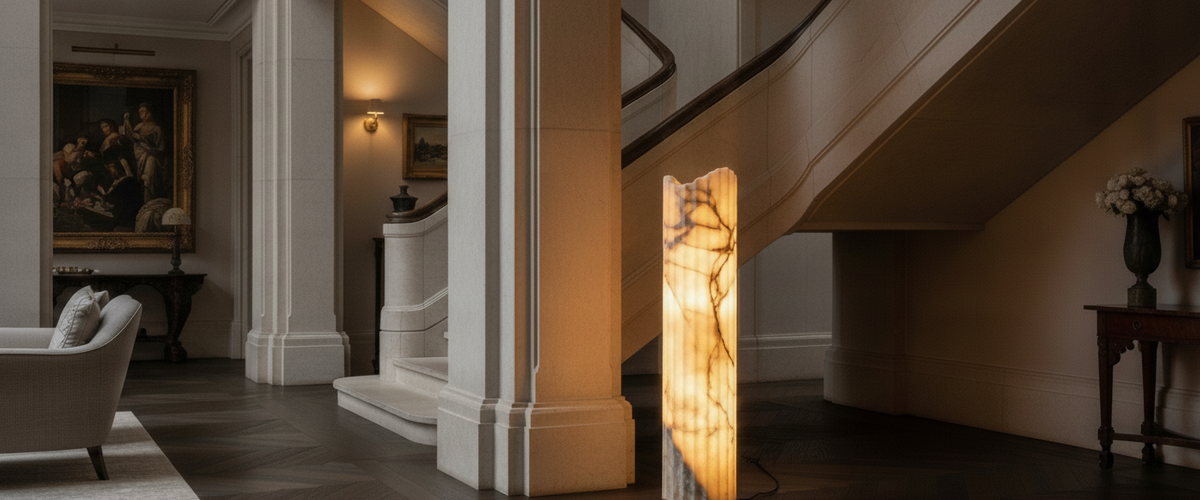
An alabaster column reads as ambient light rather than a reading source.

Key Takeaways
A floor lamp does four jobs (reading, ambient fill, corner lift, and visual anchor) and you should buy for one or two, not all four.
Arc lamps reach light over a sofa without a table, but they need real floor clearance and a heavy counterweight base.
Torchiere uplight softens a room; directional shades give you proper reading light. Most rooms are short of one of these.
Aim for the shade or light source roughly at eye level when you are seated, usually 58 to 64 inches (147 to 163 cm) tall.
Finish and shade decide whether the lamp disappears into the scheme or anchors it.

The Four Jobs a Floor Lamp Does
Reading light wants to be directional and close to your shoulder. Ambient fill wants to be soft and spread wide. Corner lift wants to push light up and outward, away from a dark angle in the room. And then there is the lamp as an object, the thing that holds a corner together when every light in the house is off. Trouble starts when you ask one fixture to be all four.
A torchiere bouncing light off the ceiling is brilliant for ambient fill and corner lift, and useless for reading. A directional reading lamp does the opposite. An alabaster column lamp, lit through the stone, sits firmly in the ambient and anchor camp; the veining glows, the light is gentle, and nobody is going to read small print by it. Knowing that in advance saves a return.
Arc Floor Lamps over a Sofa: Reach and the Clearance Nobody Measures
An arc floor lamp earns its keep where you want light over a sofa or a reading chair but cannot fit a side table. The long curved arm carries the shade out over the seating, so you get light where you actually sit while the base stays tucked behind or beside the furniture. A good lamp floor arc design lives or dies on two numbers: reach and counterweight.
Reach is how far the head extends from the base. Measure from the back of your sofa to the spot above where you want the light to land, then check the arc clears it. We have shipped arc floor lamp orders where the customer loved the curve, set it up, and found the head landed a foot short of the cushion. The base sits behind the sofa, so the arm has to travel the depth of the sofa plus a little more. Where you want that long reach with a warmer, grounded material rather than cold chrome, a wood-veneer design such as the Ginger LED Large Arc Floor Lamp carries the curve while keeping the base visually heavy enough to settle behind a sofa.
An arc reaches light over seating, but only if the curve clears the cushion.
Counterweight is the other half. A long arm wants to tip, so a serious arc floor lamp carries a dense base, often marble or stone, to hold it down. That base is heavy on purpose. If you are buying online, check the base weight, because a light base under a long arm is a topple waiting to happen, especially in a home with children or a curious dog.
Leave clear floor around the base. The arm sweeps out into the room, and people walk into the head if there is not enough space between the seating and the nearest path. In a tight room, the arc is the wrong choice no matter how good it looks.
Torchiere Uplight Versus Directional Reading Light
A torchiere floor lamp throws its light upward, washing the ceiling and letting it fall back down soft and even. In a room with a pale ceiling it is one of the quietest ways to raise the whole light level without a single downlight. It flatters plaster, it kills the cave-like feeling that overhead spots can leave in the evening, and it gives you ambient light you can dim low.
What a torchiere will not do is light your page. For reading you want a directional source, a shade or spotlight angled down onto your lap from above and slightly behind your shoulder. Where the brief is precise task light rather than a general wash, the Zephyros 2 Light Floor Spotlight in matt black is closer to the right design language, with adjustable heads you can aim at a chair or a piece of art. Most living rooms are short of one of these two functions. Walk your room at night and ask which is missing: is it gloomy overhead, or is it impossible to read in your favourite chair? Buy for the gap.
People often ask about smart options like a Govee floor lamp, the kind that does colour-changing RGB light through an app. Those are a different proposition: mood and effect lighting rather than the warm, material glow we work with. There is nothing wrong with wanting a colour wash behind a television, but it is a separate purchase from the lamp that lights your reading chair or anchors the room. Do not expect one product to cover both.
Slim Columns for Tight Corners, Statement Pieces That Anchor a Space
Not every floor lamp should be seen. In a narrow corner, beside a console, or in a hallway, a slim column does its work and stays out of the way. A lit alabaster or onyx column reads as a soft vertical glow, useful where you want light and a little warmth without adding visual bulk. These suit smaller rooms and flats where a wide shade would crowd the space.
At the other end sits the statement floor lamp, the piece that holds a corner of an open-plan room on its own. A carved stone base, a sculptural arc, a generous shade: these anchor a space the way a small piece of furniture does. If your living room reads as flat and under-furnished in a corner, a single well-chosen modern floor lamp can fix it more cheaply than another armchair. Where you want that anchor to read as glowing glass rather than solid stone, a piece such as the Dusk Dawn LED Floor Lamp in gold glass holds a corner while keeping the light soft and diffused. You can see the range of shapes across our lighting collection to get a feel for which scale your room wants.
Finish and Shade: Disappear or Dominate
Finish decides how loud the lamp is when the light is off. A matt black stem recedes against a dark wall and reads as a clean line. Brushed gold or antique brass catches the eye and behaves like jewellery in the room. Natural stone and alabaster sit somewhere in between; the veining gives them presence even unlit, which is part of why we like them. If you already have a lot going on (patterned wallpaper, a busy gallery wall) a quieter finish keeps the peace. If you are weighing finishes more broadly, our guide to choosing alabaster lighting covers how stone reads in different rooms.
The shade does the work of shaping light. An opaque shade with an open top and bottom gives you both downward task light and an upward wash. A fully translucent stone or glass shade glows all over and reads as ambient. A tight directional shade aims a beam. Match the shade to the job you settled on earlier, and the lamp behaves. Get it wrong and you have a reading lamp that lights the ceiling.
Positioning Relative to Seating, Sockets, and Your Light Layers
Height first. As a rule, the bottom of the shade or the light source should sit around eye level when you are seated, which lands most floor lamps between 58 and 64 inches (147 to 163 cm) tall. Too low and you stare into the bulb; too high and a reading lamp throws light past you onto the floor. For an uplighter, taller is fine because the light is going up.
For placement in a living room, the strongest spot is usually beside a sofa or armchair, slightly behind the shoulder for reading, or in the corner the overhead light cannot reach for ambient fill. Avoid stranding a lamp in the middle of a wall with nothing around it; a floor lamp wants a piece of furniture or a corner to relate to.
Sockets decide more than people admit. A trailing cable across a walkway is a hazard, so plan the lamp near a socket or where a cable can run safely along the skirting. The Royal Society for the Prevention of Accidents is clear that trailing leads across floors are a common trip risk, so route the cable, do not just hope. If any fixed wiring is involved, use a qualified electrician.
Finally, treat the floor lamp as one layer among several. It should work with your pendants, wall lights, and table lamps, not fight them. A torchiere lifting the ambient level lets you dim everything else; a focused reading lamp lets you switch the big overhead off entirely. If you want to see how stone fixtures behave as a soft, warm layer, the alabaster lighting collection shows the kind of diffused glow that pairs well with directional task light elsewhere in the room.
A Quick Buyer's Checklist
Decide the main job: reading, ambient fill, corner lift, or anchor.
For an arc, measure reach against your seating and check the base weight.
Confirm height suits a seated eye line (around 58 to 64 inches, 147 to 163 cm).
Match the shade type to the job, not just the look.
Choose a finish that either recedes or stands out, on purpose.
Site it near a socket and keep the cable off walkways.
Check it works with the lights you already have.