
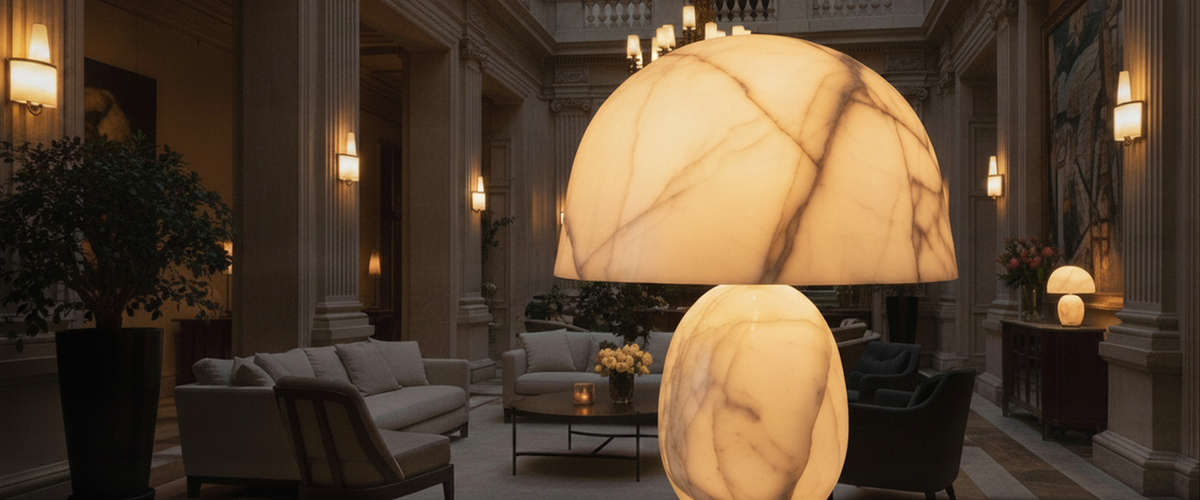

The fastest way to ruin a beautiful alabaster lamp is to clean it the way you would clean glass. A quick wipe with a wet cloth feels harmless, yet it can leave a pale shadow that never fully lifts. Alabaster behaves more like a sponge than a sheet of glass, and once you understand that, knowing how to care for alabaster lamps becomes mostly common sense. This guide is for buyers, designers, and venue owners who have just invested in a piece they want to keep looking right for decades.

Quick Answer: Caring for Alabaster at a Glance
Dust dry, not wet. A soft dry cloth or a clean dry brush is your everyday tool when you care for alabaster lamps.
Keep water off the stone. A damp cloth can leave a permanent watermark because alabaster is porous.
Mind the bulb. Use low-heat LED bulbs at a sensible wattage so heat never builds inside the shade.
Touch with clean hands. Oils and fingerprints sink in slowly and dull the surface.
Some changes are not damage. Veining shifts and faint warming are natural to the stone.
Know when to stop. Deep marks and chips are a restorer's job, not a DIY one.

Why Alabaster Is More Porous Than You Expect
Alabaster is a fine-grained gypsum stone, prized for centuries because light passes through it in a soft, even way. That same softness is the catch. It sits at roughly 2 on the Mohs hardness scale, far below marble at about 3 to 4 and granite at 6 to 7, which is exactly why carvers can cut such delicate translucent walls into a shade. Alabaster has been worked into vessels and lamps since antiquity precisely because it is easy to carve, and you can read more about its long use as a sculptural material through the British Museum collections.
For weekly care, the practical takeaway is this: the surface drinks in moisture and absorbs oils. It is not sealed like a kitchen worktop. The first reason to care for alabaster lamps differently is that simple. Treat it as a natural, breathing material and you will avoid almost every common mistake. We make this point with every client who orders a large piece from the alabaster lighting range, because the care routine is genuinely different from anything they own in glass or metal.
The Water Rule: Why a Damp Cloth Leaves a Shadow
Here is the rule that saves the most heartache, and it sits at the center of how you care for alabaster lamps. Do not put water on raw alabaster. A damp cloth seems gentle, but the moisture wicks into the stone faster than you can wipe it away, and as it dries it can leave a cloudy ring or a darker patch that takes weeks to fade, if it fades at all. We once had a client in a converted barn ring us in a panic after wiping a pendant with a kitchen sponge. The pale halo took the best part of a month to settle, and that was a lucky outcome.
If something sticky lands on the surface, resist the urge to scrub. Lift it gently with a barely-there touch of a slightly damp cloth on that one spot, then immediately dry the area with a clean cloth and let it breathe. The aim is contact measured in seconds, never a wet wipe-down. When you care for alabaster lamps day to day, dry is always the safer default.
Dust, Oils, and Fingerprints: The Slow Damage Nobody Photographs
Watermarks are dramatic. The quieter problem is the slow build of dust and skin oils, and it is the one that ages an alabaster lamp most over years. Dust settles into the texture and the carved grooves, and over time it dulls the glow that made you buy the piece. Fingerprints leave oil that the stone absorbs, so the surface gradually looks greyer in the spots people touch most.
To care for alabaster lamps properly, your routine should be light and frequent rather than heavy and rare:
Dust weekly with a soft, dry microfibre cloth or a clean, soft-bristled brush for carved areas.
For a floor-standing piece such as the Atria LED Large Alabaster Floor Lamp, which people regularly brush past at hand height, a quick dry buff once a week keeps oils from setting into the most-touched edges.
Handle the shade by its base or fittings when adjusting it, not by the translucent walls.
Keep cleaning products well away. No sprays, no polish, no glass cleaner, no all-purpose spray. They can stain or etch the stone.
If you are styling a piece in a dusty environment, say a barn conversion or a busy hospitality space, lift the dusting to twice a week. It takes thirty seconds and protects the finish you paid for. If you are still weighing materials before you buy, our guide on choosing between alabaster, marble, and onyx lighting walks through how each stone behaves in a room.
Heat From the Bulb: Choosing Wattage That Protects the Stone
People worry about cleaning and forget the thing running inside the lamp every evening. Heat is a real factor when you care for alabaster lamps, because natural stone reacts to it. Alabaster can develop hairline stress over time if it is repeatedly heated and cooled by a hot, high-wattage bulb sitting close to a thin carved wall. The fix is simple and modern: use cool-running LED bulbs.
A few buying notes that keep the stone comfortable:
Choose LED over halogen or incandescent. LEDs run far cooler and protect the stone over the long term.
Stay within the fixture's stated maximum wattage. Never overshoot it to make a piece brighter.
Aim for warm colour temperature, roughly 2400K to 2700K, which flatters alabaster's natural warmth instead of fighting it.
Pair with a compatible dimmer. Soft, low light is where alabaster looks its best, and dimming also reduces heat load.
Where the heat question matters most, an integrated fixture removes the guesswork entirely: a sealed-in low-heat unit like the Aleron LED Large Round Alabaster Flush Ceiling Light protects the stone by design, so there is no bulb to over-spec against a thin carved wall. If you are choosing across the wider lighting collection, check whether a piece takes a replaceable bulb or has integrated LED, and match your dimmer accordingly.
Yellowing, Veining Shifts, and Changes That Are Not Damage
Natural stone moves. A new alabaster lamp may look slightly different in your home than it did online, and over years it will keep changing in subtle ways. Most of this is character, not damage, and learning to care for alabaster lamps means telling the two apart.
Expect a gentle warming of tone as the stone ages, sometimes read as faint yellowing, which usually deepens the warmth of the glow rather than spoiling it. The veining can also appear to shift as light hits it from different angles and at different times of day; a vein that looks faint at noon can read strongly under a dimmed evening bulb. Each piece is cut from a unique block, so two lamps from the same design will never match exactly. The Getty publishes useful conservation material on how natural and historic stone surfaces age, which is worth a read if you like to understand the material you live with.
What is not normal: a sudden dark patch (usually moisture or oil), a powdery residue, or a crisp pale ring (usually a watermark). Those have a cause you can trace back to handling. The slow, even shifts in colour and veining do not.
When to Call a Restorer and When to Leave It Alone
The hardest part of looking after these lamps is knowing when to do nothing. Plenty of marks settle on their own, and overworking the surface causes more harm than the original mark. Part of learning to care for alabaster lamps is sitting on your hands.
Leave it alone when: the mark is a faint watermark that is already fading, the change is an even shift in tone across the whole piece, or the veining simply looks different under new lighting. Time and patience fix more than any product will.
Call a professional stone restorer when: there is a chip or crack, a deep stain that has clearly sunk in, a scratch you can feel with a fingernail, or any structural concern with how the lamp is mounted. A restorer can re-finish and consolidate alabaster in ways that home remedies cannot, and they will not gamble with a piece this soft. For anything electrical, a chip near a fitting or a flickering integrated unit, stop and bring in a qualified electrician rather than working on the wiring yourself.
A Simple Care Checklist
Dust dry, weekly, with a soft cloth or brush.
Keep water and all cleaning sprays off the stone.
Handle by base and fittings, not the translucent walls.
Use warm, low-heat LED bulbs within the rated wattage.
Dim for mood and to keep heat down.
Accept natural tone and veining changes as character.
Call a restorer for chips, cracks, and deep stains.
When you care for alabaster lamps this way, they do not just survive; they get better. The glow softens, the warmth deepens, and the piece becomes the one thing in the room people keep glancing at. That is the quiet reward for treating natural stone as the living material it is, and the reason it pays to care for alabaster lamps with a light hand.