

A narrow hallway is the one space where a lighting mistake follows you every single day. You walk it in the morning, you walk it at night, and a glaring downlight or a fixture that clips your shoulder becomes a small daily irritation. Good narrow hallway lighting ideas start long before you pick a finish; they start with how the corridor is used, how wide it really is, and what kind of light a material can give back. At Niori we make alabaster and natural-stone lighting, and the tight corridor is a brief we get asked about constantly, usually after a buyer has already tried two harsh fittings that did not work.
Here is the part most guides skip: the corridor is a tight, high-traffic channel, and the light has to be warm and even without crowding the space. That is exactly where carved stone earns its place, and it is why the best narrow hallway lighting ideas always begin with the material.
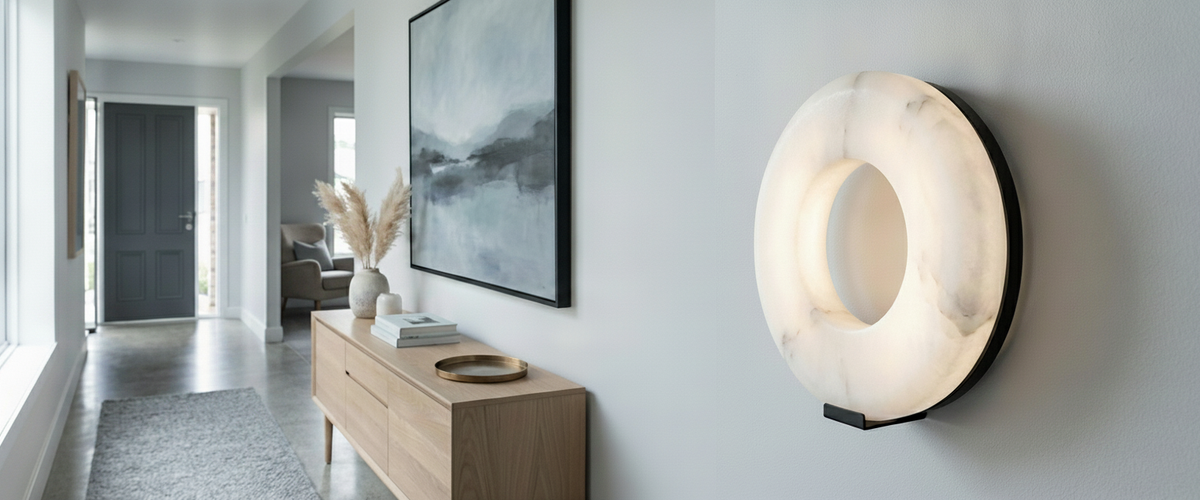
A repeated run of shallow alabaster wall lights draws the eye down a tight corridor.

Key Takeaways for Narrow Hallway Lighting
Layer, do not blast. A run of soft wall lights usually beats one bright ceiling fitting in a tight corridor.
Watch projection. Measure how far a fixture sits off the wall or drops from the ceiling before you commit.
Material shapes the mood. Alabaster diffuses light into a warm, low-glare glow that flatters narrow spaces.
Veining is not random. The way stone is cut decides how the piece looks lit and unlit.
Wiring is a qualified-electrician job. Plan circuits and dimming early, not after the plaster is done.

What Makers Think About Before Crafting These Schemes
The first question in the workshop is never "what looks good". It is "how wide is the corridor, and where do people's shoulders go". A hallway under roughly 3 feet (about 0.9 m) wide cannot take a deep wall light without it becoming a hazard. That single measurement rules out half the catalogue before we talk about style at all, and it shapes most narrow hallway lighting ideas worth chasing.
Next comes height and rhythm. The best hallway lighting ideas for a long run lean on a repeated element, so two or three matched alabaster wall lights spaced evenly will pull the eye down the corridor and make it feel longer rather than boxed in. A single central pendant, by contrast, tends to light one pool and leave the ends gloomy. For ceiling-led schemes we look at recessed or low-profile fittings that sit close to the plaster, then add stone wall lights for warmth at eye level. If you are after hallway ceiling light ideas specifically, a flush or semi-flush fitting earns its place where the space opens out.
The third thing is glare. In a tight space your eye is close to the source, so a bare lamp or a thin glass shade will dazzle. Alabaster handles this almost by accident: the stone is dense enough to hold back the hot point of the bulb and release a soft, even wash instead. That low-glare quality is what makes alabaster the backbone of so many narrow hallway lighting ideas. If you want to compare the fixture types that suit a corridor, the full range on our lighting collection is a sensible place to start before you narrow down to wall or ceiling.
Craft Decisions That Change the Result and the Price
Buyers often assume the price of a stone fixture is mostly about size. Size is rarely the main driver. The bigger variables are the grade of the block, how much of it is wasted to find clean veining, the depth of the carving, and the finishing time at the end. These are the details behind any costing of narrow hallway lighting ideas.
A few choices that quietly move both the look and the cost:
Solid carved stone versus stone-clad. A piece carved from a single block reads differently when lit than thinner panels mounted to a frame. Solid carving uses more material and more hours.
Backplate and arm detailing. Brass detailing on a wall light has to be finished by hand to sit cleanly against the stone. That handwork is real labour.
Edge treatment. A crisp machined edge and a softer hand-honed edge catch light in different ways. One is sharper, one is gentler; both take time.
Integrated versus replaceable lamps. Integrated LED looks clean but ties you to that module; a replaceable bulb is easier to live with long term.
We do not publish a flat price for a corridor because the honest answer depends on material grade, scale, complexity, the engineering behind the mount, and the finishing. The sensible move is to describe your hallway and request a tailored quote rather than guess from a number you saw elsewhere.
Why Stone Selection and Veining Make or Break the Glow
Alabaster is a form of gypsum that makers have carved and lit for centuries; the Victoria and Albert Museum holds carved alabaster pieces that show how long the material has been valued for its glow, and you can read about it on the V&A collections pages. What matters for a hallway is that no two blocks behave the same once light passes through them, and that variation is central to good narrow hallway lighting ideas. If you want a deeper look at the material itself, our guide to alabaster lighting and how it is made covers why the stone behaves the way it does.
Backlit veining becomes the structure of the glow, which is why block selection matters.
Veining is the signature. In daylight it reads as quiet pattern across the surface. Switch the fixture on and those same veins become the structure of the glow, with denser bands holding back light and translucent zones letting it through. A maker chooses the cut to control that. Cut one way and the veins run with the length of a wall light, drawing the eye along the corridor; cut another and they fan out and feel busier.
This is why we are fussy about the block before carving begins. A narrow hallway puts the fixture close to your face, so any flaw or muddy patch shows. We have turned down stone that looked fine dry but went cloudy and uneven the moment it was backlit on the test rig. For onyx and marble pieces the same rule applies: the lit appearance is the real product, and the unlit appearance is only half the story.
Inside the Workshop: From Block to Installed Fixture
The order of work is fairly fixed, and each stage feeds the next. Follow it and the narrow hallway lighting ideas on paper turn into a fixture that behaves on the wall.
Stone selection. Blocks are checked dry and then backlit so the veining and translucency can be judged under real light, not showroom light.
Carving and shaping. The form is roughed out, then refined. Wall lights for tight corridors are kept shallow on purpose so they sit close to the plaster.
Finishing. Surfaces are honed or polished by hand. This is where the edge treatment and the final glow are decided.
Wiring and assembly. The lamp holder, driver and any brass fittings are set so the bulb sits where the diffusion works best. Get this wrong and you create a hot spot.
Install. The fixture is mounted and commissioned. Final positioning and the connection to the mains should always be done by a qualified electrician.
For a corridor scheme, we tend to suggest wall lights as the workhorse and a flush or semi-flush ceiling fixture only where the hallway opens out or turns. If you are browsing hallway light fixture ideas and want to see how the carved-stone pieces are built, the alabaster lighting range shows the fixture types side by side.
Bulbs and Dimming for a Tight Corridor
Stone rewards a warm bulb. Aim for a colour temperature around 2700K so the alabaster reads honey rather than blue, and use a high colour-rendering lamp so the wood, paint and art in the hallway look true. A hallway is a circulation space, so it needs enough light to move through safely without flooding the corridor. This is where many narrow hallway lighting ideas come undone, by chasing brightness over balance.
Dimming matters more here than in most rooms. A hallway is a transition, so you want it bright enough to feel safe on a school morning and low enough to act as a soft night-time guide. Specify a dimmable driver and a compatible dimmer from the start; retrofitting dimming after install is a common, avoidable headache. If you run wall lights on one circuit and a ceiling fitting on another, you can flex the balance through the day. These small specification choices separate workable hallway light ideas from ones you end up replacing.
Honest Red Flags to Ask About Before You Commit
A specialist will welcome these questions, and they sit at the heart of practical narrow hallway lighting ideas. Anyone who dodges them is worth a second look.
How far does it project? Get the exact depth off the wall or drop from the ceiling, then walk it in your head against your corridor width.
Is it solid stone or clad? Both are valid, but you deserve to know which you are buying and how it lights.
What lamp does it take, and can I replace it? Integrated modules can be elegant but harder to service.
Is it sold dimmable? Confirm the driver and compatible dimmers before purchase.
How is the stone sealed and cleaned? Alabaster is porous and dislikes water and harsh sprays; a dry microfibre cloth and the occasional careful dust is the right routine.
What is the lead time? Carved stone is made to order, so plan around the build, not an off-the-shelf shipping date.
The best hallway lighting fixtures ideas live or die on small, practical decisions: width, projection, warmth, and the cut of the stone. Get those right and the corridor stops being the leftover space between rooms and starts pulling its weight. Strong narrow hallway lighting ideas are quiet, not loud. If you are weighing fixtures for a tight hallway, start from the homepage at Niori and tell us the dimensions; the right answer is usually a quiet run of wall lights, not one bright fitting trying to do everything.