
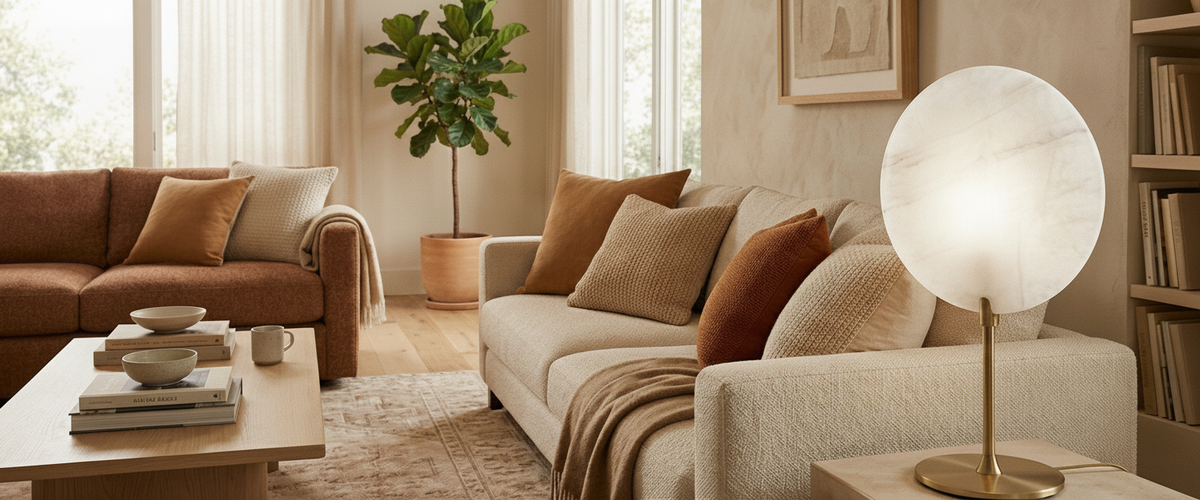

Most living rooms are lit as an afterthought: one ceiling fitting, a couple of lamps wherever the sockets happen to be, then years of squinting at the wrong end of the sofa. Get the layers right and the room does something quieter and more useful. Good living room lighting tells people where to sit, where to read, and where the evening softens into something calmer. Alabaster and natural stone do this particularly well, because the material itself diffuses light through its body rather than firing it back at you.
Below is how we think about living room lighting at Niori, drawn from rooms we have actually shipped to and the corrections we make again and again.

Key Takeaways
- Treat a living room as three or four lighting zones, not one big switch.
- Mounting height and sightlines decide whether a fixture reads as architecture or clutter.
- Warm bulbs (around 2700K) on dimmers carry the evening mood; cooler light flattens it.
- Alabaster and stone give a soft, glare-free glow that suits long evenings of sitting and reading.
- Budget depends on material, scale, and installation, so ask for a tailored quote rather than guessing.

How Light Steers Where People Sit and Gather
People drift toward pools of warm light the way they drift toward a fire. If the only bright spot in your living room is a single ceiling fixture, everyone ends up sitting directly under it or in shadow at the edges. Good living room lighting spreads the light into deliberate pools so you can shape the whole room: a reading chair by the window, a low glow over the coffee table, a warm wash on the wall behind the sofa.
This is where alabaster earns its place. A table lamp with an alabaster shade throws light through the stone, so the source is soft and the surrounding surfaces catch a gentle halo. You get a comfortable place to sit without a hard hotspot. A floor lamp, or stand light, does the same job for a reading corner, lifting the light to shoulder height where it actually helps a book. When clients ask for living room light fixtures that make a space feel inviting rather than merely bright, this layering is almost always the answer.
Mounting Height and Sightlines
The single most common fix we make is height. A pendant or small chandelier hung too high floats awkwardly and lights nothing in particular; hung too low it blocks the view across the room. Over a coffee table, aim for the bottom of the fixture to sit roughly 5 to 6 feet (around 1.5 to 1.8 metres) off the floor, so it reads as a glowing object without cutting through eyelines on the sofa.
Wall lights deserve the same care, and they are an underused part of living room lighting. Mounted at around 5 to 5.5 feet (1.5 to 1.7 metres) they sit at eye level for someone standing and just above it for someone seated, which keeps the source out of direct view. Alabaster wall lights are forgiving here because the stone hides the bulb; you see a warm panel of light rather than a glare. Walk the room before you commit. Sit on the sofa, look toward each proposed fixture, and check whether you are staring straight at a bulb. If you are, move it.
Zoning an Open-Plan Living Space
Open-plan rooms are where living room lighting plans fall apart, because there are no walls to tell the eye where one area ends and the next begins. Light does that work instead. A low pendant or a pair of matched table lamps over a seating cluster pulls it together as a room within the room. A separate set of fittings marks the dining end. Each zone gets its own switch or dimmer channel so you are never forced to light the whole floor at one level.
The trick is to keep a common thread so the space still reads as one. We often run alabaster across the zones: a stone pendant over the table, alabaster table lamps by the sofa, a wall light or two near the entrance. The material and the warmth of the glow unify everything even when the fixtures differ. You can browse the range across the alabaster lighting collection to see how pendants, lamps, and wall lights share that family resemblance.
Living Room Ceiling Lights and the Overhead Layer
Living room ceiling lights are useful, but they should rarely be the star of your living room lighting. Their job is general fill: enough light to cross the room safely, find a dropped remote, or clean. Recessed downlights (can lights) handle this discreetly, and a central pendant or chandelier adds character above the main seating area. The mistake is asking the overhead layer to do everything. A single bright ceiling source flattens faces, kills shadow, and makes a living room with light feel more like an office than a place to relax.
If you want a sculptural centrepiece, an alabaster or onyx chandelier works because it diffuses rather than glares. The stone glows as an object in its own right, then the lamps inside carry usable light below. Pair it with table lamps and wall lights and you have a complete scheme. The full spread of fittings sits in the lighting collection if you want to plan zones together.
Bulb Temperature, Dimming, and the Evening Mood
Colour temperature decides whether your evening room feels warm or clinical, and it is the part of living room lighting people get wrong most. For a living space, aim for warm white bulbs around 2700K. That is the warmth of a low sun and it flatters skin, wood, and stone alike. Cooler 4000K light can read as blue and unforgiving after dark, which is why so many rooms feel oddly tense in the evening without anyone knowing why.
Dimming matters just as much as temperature. Put your main fixtures on dimmers and you can drop the room from bright (for cleaning or daytime tasks) to a low, even glow for an evening. Choose LED bulbs rated as dimmable and check they are matched to your dimmer; mismatched pairs flicker or hum. The Chartered Institution of Building Services Engineers publishes useful guidance on lighting levels and quality if you want to read further into how brightness and comfort relate (cibse.org).
On wattage: with LEDs, think in lumens, not watts. A relaxed lounge rarely needs more than a few hundred lumens per lamp at the seating layer, built up across several sources rather than one fierce fitting. Alabaster shades lower the apparent brightness because the light passes through stone, so you can run a slightly warmer, gentler bulb and still get a glow that fills the corner.
Placement Mistakes We Keep Fixing
A few living room lighting patterns come up so often they are worth naming.
- One light, one room. Relying on a single ceiling fixture is the root of most dull living rooms. Add lamps and wall lights at lower levels.
- Lamps lined up like soldiers. Matching table lamps either side of a sofa look tidy but light only that one spot. Vary heights and spread sources around the room.
- Can lights in a grid. Evenly spaced downlights across the whole ceiling flatten the room. Cluster them where you need task light and leave the rest to softer sources.
- Bulbs you can see. Any fixture that puts a bare bulb in your eyeline from the sofa will annoy you every evening. Alabaster and stone hide the source, which is half the reason they read so well in a relaxed room.
- Cool bulbs after dark. A 4000K bulb in a lounge makes the warmest sofa feel like a waiting area. Keep it warm.
A Quick Living Room Lighting Checklist
- Map three or four zones: main seating, reading corner, a dining or console area, and general fill.
- Pick a layered set of living room lights: an overhead piece, lamps at table height, wall lights at eye level.
- Set pendant fixtures so the base sits around 5 to 6 feet (1.5 to 1.8 metres) off the floor.
- Choose dimmable LEDs around 2700K and confirm dimmer compatibility.
- Sit on the sofa and check no bulb is in your direct line of sight.
- Wire anything new through a qualified electrician, especially recessed can lights.
Caring for Alabaster and Stone in a Lived-In Room
Stone fixtures reward a little routine. Dust alabaster and marble with a dry, soft cloth; the surface is porous, so skip household sprays and anything abrasive. Lift dust gently rather than rubbing it in. Keep lamps away from radiators and direct heat, and let LED bulbs do the heavy lifting since they run cool and protect the stone over years of use. Treated this way, an alabaster lamp keeps its quiet glow for a very long time.
Living room lighting is less about buying the right single fixture and more about composing a few good sources that agree with each other. Get the layers, the heights, and the warmth right, and your living room lighting starts directing the room itself.