
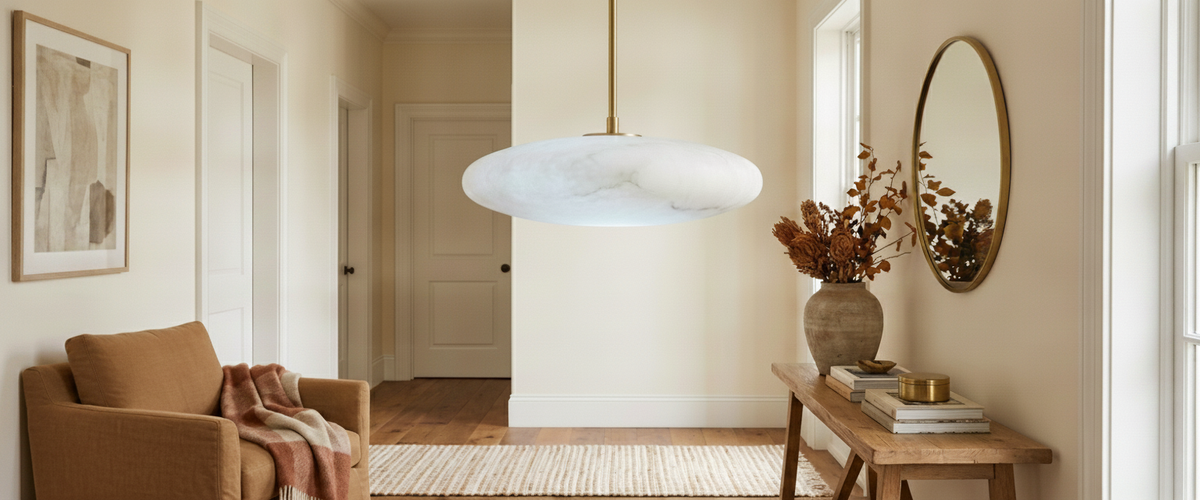

The hallway is the first space your guests read and the last one most people get round to lighting properly. It tends to inherit whatever ceiling fitting came with the house, a single harsh bulb doing the work of three. Good hallway lighting ideas start with a simple admission: this is a room people pass through, but it sets the tone for everything beyond it. Get the light right and a narrow, awkward corridor reads as deliberate. Get it wrong and even a generous entrance feels like a service passage.
Alabaster and natural stone are quietly suited to this job. The best hallway lighting ideas use a material that softens and spreads light rather than throwing it in a hard pool, so a hallway lit with an alabaster pendant or wall light feels warm and even instead of glary. That diffusion matters most in tight spaces, where a bare bulb at eye level is something you notice every single day.
An alabaster pendant softens the glow in a narrow entrance.

Key Takeaways Before You Buy
Layer the light. One ceiling fitting rarely covers a hallway. Pair an overhead with wall lights or a slim table lamp on a console.
Match the fixture to the ceiling height. Flush and semi-flush for low ceilings, pendants and chandeliers where you have the drop.
Warm, dimmable light wins. Aim for a warm colour temperature and put the hall on a dimmer so it can shift from bright morning to low evening.
Alabaster diffuses; polished stone reflects. The material changes how the glow behaves, not just how it looks switched off.
Scale to the corridor, not the catalogue photo. A piece that looks right in a double-height stairwell will overwhelm a narrow flat hallway.

What Hallway Lighting Ideas Really Mean, and Who They Suit
These hallway lighting ideas cover everything from a single statement pendant over a stairwell to a run of discreet wall lights guiding you along a corridor. The right approach depends almost entirely on the shape of your space. A wide period entrance hall with a staircase can carry a chandelier; a narrow Victorian terrace hallway needs something that hugs the ceiling and pushes light forward rather than down. Plenty of good hallway light ideas come down to that one read of the room.
This approach suits anyone treating the hall as part of the home rather than dead space between rooms. We hear from homeowners renovating a first impression, interior designers staging a sequence of rooms, and hospitality clients who know guests judge an entrance within seconds. One designer we shipped to recently was working on a townhouse where the hallway ran nearly the full depth of the building. We helped her plan a pair of alabaster wall lights at the mid-point plus a single pendant near the door, so the corridor read as a considered route rather than one long dim tunnel.
Key Materials, Finishes and Scale Decisions
Alabaster is the natural starting point for hallway light because of how it handles a bulb. The stone is translucent enough to glow gently from within, which gives you usable light without the hot spot you get from clear glass or an exposed lamp. Each piece carries its own veining, so two alabaster fixtures from the same range are never identical. That variation is part of the appeal; it reads as natural material rather than moulded plastic. The Natural Stone Institute describes alabaster as a soft, fine-grained stone (naturalstoneinstitute.org), which is exactly why it carves into the smooth, light-friendly forms behind so many good hallway lighting ideas.
Marble and onyx behave differently. Onyx has stronger, more dramatic banding and a bit more translucency in thin sections, so it suits a feature piece you want people to notice. Marble is denser and tends to read as solid mass, which works beautifully on a lamp base or a wall light backplate paired with brass detailing. If you want the stone itself to be the focus when the light is off, marble and onyx deliver. If you want the glow to be the focus when it is on, alabaster usually wins.
Brass detailing earns its place in a hallway. It warms up the palette, ages gracefully, and ties a fixture to door furniture and console hardware. For finishes, decide early whether you want polished brass that catches the eye or a softer brushed finish that recedes. Browse the range across the alabaster lighting collection to see how the same stone reads against different metal tones.
Scale is where most hallway lighting ideas go wrong. A common mistake is buying a fixture that looked generous in a wide showroom shot and finding it crowds a 90cm (roughly 3 feet) wide corridor. As a rough rule, a hallway pendant should leave clear headroom for the tallest person who uses the space, and a wall light should sit so the bottom edge falls around eye level or just above. Measure the actual width and ceiling height before you fall for anything.
Narrow Hallway Lighting Ideas and Ceiling Choices
Narrow hallway lighting ideas live or die on ceiling height. Where the ceiling is low, a flush or semi-flush alabaster fixture is the safe, smart choice. It washes the ceiling and the walls without dropping into the walkway, and the diffused stone stops the fitting feeling clinical. For hallway ceiling light ideas in a corridor with a little more height, a compact pendant or a short row of two small pendants spaces the light along the route rather than leaving one bright patch and two dark ends. These are the hallway lighting ideas that pay off most in tight footprints. If a stairwell sits at the end of your hall, our staircase lighting ideas guide goes deeper on lighting treads and voids safely.
Evenly spaced alabaster wall lights give a long corridor rhythm.
Long corridors benefit from rhythm. Instead of fighting to light the whole length from a single source, repeat a smaller hallway light fixture along the wall. A trio of matching alabaster wall lights, evenly spaced, draws the eye forward and makes the space feel intentional. This is one of the most reliable hallway lighting fixtures ideas for terraces and flats where the hall is essentially a passage.
For wider entrance halls and stairwells, you have room to make a statement. A single alabaster chandelier or a larger pendant hung in the stairwell void anchors the space and carries light up and down the stairs. You can compare pendants, chandeliers and wall lights side by side across the broader lighting collection to see which hallway lighting ideas fit your ceiling.
Where to Place Hallway Lighting for the Strongest Impact
Layering is the single most useful habit, and it sits at the heart of the best hallway lighting ideas. A hallway lit from one point always has a bright centre and gloomy edges. Combine an overhead fitting with wall lights, and add a table lamp on a console near the door if you have the surface. That console lamp does quiet work; it gives you a low, welcoming glow for late evenings without flooding the whole hall, and it lights the spot where keys, post and bags actually land.
Light the staircase deliberately. Where a hall meets stairs, the change in level is exactly where people need clear, even light to feel safe. A wall light at the turn of the stairs or a pendant that reaches into the void both work, and either belongs in your shortlist of hallway lighting ideas. Treads in shadow are a genuine hazard, so this is one area where you light for function first and good looks second, and a soft alabaster glow lets you do both.
Mind the mirror. Most hallways carry one, and a mirror placed opposite or beside a stone wall light doubles the glow and visually widens a narrow space. It is a cheap trick that makes an expensive fixture work harder.
Bulbs and Dimming
Choose a warm colour temperature for a hallway; somewhere in the warm white range feels welcoming rather than corridor-clinical. Put the hall on a dimmer so it can be bright when you are heading out in the morning and low when you are settling in at night. Most hallway lighting ideas only come together once the dimming is right. Use dimmable LED lamps rated for your fixtures, and check that your chosen dimmer is compatible, since the wrong pairing causes flicker and buzz. The IES offers solid background on lighting quality and glare control if you want to read further (ies.org). Any new wiring or fixture install should be done by a qualified electrician.
Budget, Quality and Delivery Considerations
Hallway lighting spans a wide range because the materials and engineering vary so much. The cost of a natural-stone fixture depends on the stone itself, the size and complexity of the piece, the metalwork, and the hand finishing. Rather than chase a price band, work out what the hall needs first (one statement piece or several smaller fittings) and then request a tailored quote for the specific fixtures.
On quality, look for solid alabaster rather than a thin veneer, well-machined brass that feels weighty, and clean joins between stone and metal. Because each stone is unique, expect natural variation in colour and veining; this is a feature of genuine material, not a flaw. For shipping, stone is heavy and needs careful packing, so plan lead times into a renovation rather than ordering at the last minute. The most considered hallway lighting ideas always leave room for delivery time.
How Niori Can Help With Hallway Lighting
Niori designs alabaster and natural-stone lighting; pendants, chandeliers, wall lights, table lamps and floor lamps, with brass and glass detailing. For a hallway, that usually means helping you balance one well-placed pendant against a run of wall lights, or pairing a flush stone ceiling fitting with a console lamp for a layered, welcoming entrance. If you want hallway lighting ideas tailored to your space, start at the Niori homepage to get a feel for the range, then talk to us about the dimensions and ceiling height of your actual hall before you commit.
Care That Keeps Stone Looking Right
Alabaster and marble are softer than they look and dislike moisture and harsh cleaners. Dust fixtures with a dry, soft cloth and avoid water and chemical sprays, which can mark the surface over time. Keep stone fittings away from damp spots, and switch off and let a fixture cool before handling. Done sensibly, the hallway lighting ideas you settle on will age slowly and gracefully, which is rather the point of buying stone in the first place.