
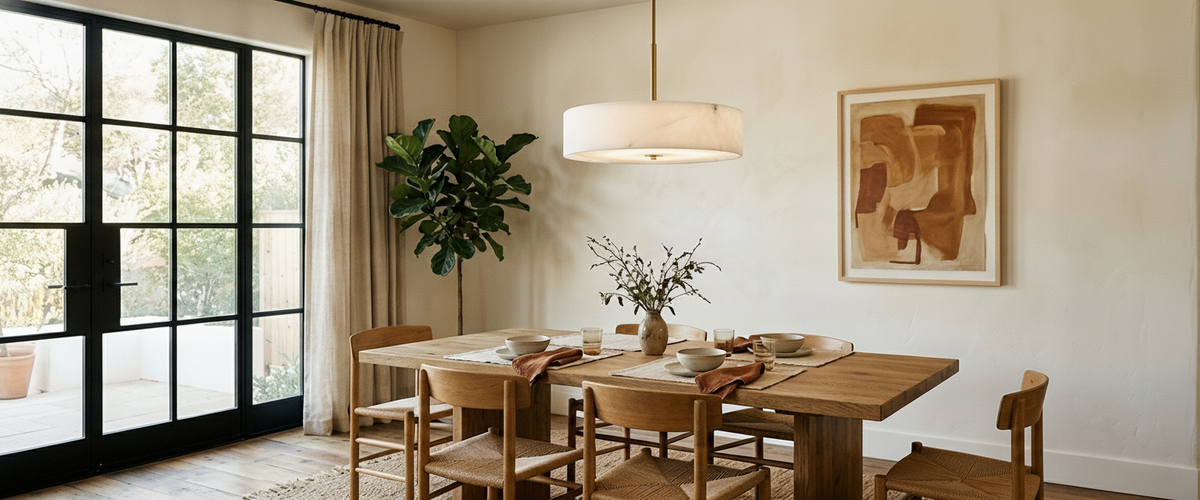

The difference between alabaster pendant light fixtures that look expensive and ones that look lost is rarely the fixture itself. It is the hanging height, the scale against the room, and what sits behind it. Get those right and alabaster pendant light fixtures read like the considered centrepieces they should be. Get them wrong and even the most beautifully carved stone floats in the wrong spot, casting light where nobody needs it.
Stone behaves differently from glass or metal. Alabaster is mildly translucent, so light passes through the body of the shade rather than bouncing off it, and the mineral veining shows up as soft shadow and warm grain when the bulb is lit. That single property changes every placement decision you make with alabaster pendant light fixtures.
A warm, diffuse glow over the table rather than a hard hotspot.

Key Takeaways Before You Hang Anything
Alabaster glows from within, so the fixture stays interesting even at low brightness; size it for presence, not just lumens.
Mounting height controls glare and sightlines more than wattage does.
Warm, dimmable bulbs flatter the stone; cool light flattens the veining and kills the appeal.
A plain, slightly darker backdrop makes a pale shade read clearly; a busy or equally pale wall swallows it.
Budget depends on material, scale, engineering, and installation, so ask for a tailored quote rather than guessing from photos.

What Alabaster Pendant Light Fixtures Actually Look Like in a Room
Switched off, alabaster pendant light fixtures are quiet, sculptural objects: pale stone, fine veining, often paired with brushed brass or a soft white fitting. Switched on, they change character. The shade warms from the centre outward, the veins deepen into shadow lines, and the light it throws is diffuse rather than directional. There is no hard hotspot on the table below, just an even pool of warmth.
That is why an alabaster pendant light tends to suit rooms where you want atmosphere alongside function. Over a dining table it gives a flattering glow without spotlighting the food. In a hallway it reads as a piece of carved stone first and a light source second. Contemporary forms tend to lean on clean linear or chevron geometry, while more traditional shapes feel rounder and softer. Both rely on the same trick: the material does the visual work, and the bulb just brings it to life. You can see the spread of shapes across our alabaster lighting collection.
Scale, Mounting Height, and Sightlines
Scale is the first thing buyers underestimate. An alabaster pendant light fixture that looks generous on a studio bench can shrink against a real ceiling and a real piece of furniture. As a rough working rule for a dining pendant, the fixture width should sit comfortably narrower than the table so it does not crowd the edges, and the bottom of the shade usually wants to land around 30 to 36 inches (76 to 91 cm) above the tabletop. Taller diners and higher ceilings push that figure up.
Mounting height does two jobs. It keeps the bulb out of seated sightlines, and it sets how much of the warm glow you actually see. Hang the shade too high and the stone reads cold and distant; hang it too low over a kitchen island and people walking past clip it with their shoulders. In open-plan rooms, check the sightline from the sofa as well as from the table. A fixture that looks balanced when you stand under it can sit at an awkward eye level when you are seated across the room.
For a modern alabaster pendant light in a double-height space, scale up rather than stacking several small fittings. One confident piece reads better than a cluster fighting for attention against tall walls, which is why a substantial fitting such as the Zareon LED Large Chevron Alabaster Suspension Light tends to hold a tall room better than several smaller shades.
A matched run over an island, with bottoms aligned and spacing even.
Room-by-Room Placement for Alabaster Pendant Lighting
Each room asks something slightly different of the fixture.
Dining Room
This is where alabaster pendant lighting earns its keep. The diffuse glow is genuinely flattering across faces and table settings, and the lack of glare means nobody squints across dinner. Centre the pendant over the table, not the room, since the two rarely line up. If your table seats eight or more, a long linear shade like the Zareon LED Large Linear Alabaster Suspension Light follows the length of the surface far better than a single round shade.
Kitchen Island
Islands need usable task light, so pair the soft ambient glow of alabaster pendant light fixtures with a layer of directional downlighting elsewhere in the ceiling. A row of two or three matched pendants suits a long island; keep the spacing even and the bottoms aligned to the millimetre, because the eye forgives almost nothing on a straight run.
Entrance Hall and Stairwell
A hallway is the one place where an alabaster light pendant can be purely decorative. Here you want presence at first sight and a warm welcome rather than working light. Over a stairwell, mind the swing of the chain or rod and the access for changing a bulb later.
Bedroom
Alabaster pendant light fixtures either side of the bed, hung low as reading lights, free up the bedside tables and give a boutique-hotel feel. Alabaster suits this because the glow is soft enough not to jar when you wake. Put them on a dimmer and you have one fixture that handles both reading and winding down. For more on pairing pendants with the rest of the scheme, our guide to layering bedroom lighting walks through how ambient and task layers work together.
Bathroom
Treat bathrooms with care. Natural stone and steamy, wet environments do not always mix, and any fixture near water needs the correct IP rating and a qualified electrician to install it. If you want alabaster in a bathroom, keep it well away from the shower zone and confirm the rating before you buy.
Bulbs, Dimming, Backdrop, and Contrast
Bulb choice can make or break the look. Alabaster pendant light fixtures want warm white, generally in the 2700K to 3000K range; anything cooler turns the stone grey and clinical and erases the warm grain that drew you to it in the first place. Many of our fixtures use integrated LED tuned to flatter the stone, while pendants that take standard bulbs give you room to choose. If you want a plain-English explanation of what a Kelvin figure means in the room, the US Department of Energy guidance on lighting is a useful primer.
Dimming matters more with alabaster than with most materials. Because the shade itself glows, a dimmed pendant does not just get darker; it gets softer and more atmospheric, and the veining becomes the main event. Where you want that soft white finish to read warm at every level, a fitting such as the Zareon LED Large Stepped Alabaster Suspension Light shows how a soft white tone and stepped form keep the glow even as you dial it down. Specify a compatible dimmer for the driver or bulb, and have your electrician confirm the pairing to avoid flicker.
Backdrop is the quiet factor people forget. A pale shade against a white wall or ceiling can disappear, since the stone and the surface share a tone. Set it against a slightly deeper colour, a panelled wall, or a darker ceiling and the fixture suddenly has an outline. Contrast is what gives a pale object its edge.
Common Placement Mistakes We See in Client Projects
We shipped a large linear suspension to a client with a long oak dining table last year, and the first thing they asked was whether the piece was too big in the box. Once it was hung at the right height, centred on the table rather than the room, it looked correctly scaled. The lesson repeats often with alabaster pendant light fixtures: a piece that feels oversized on the floor usually reads as just right in the air.
Here are the errors that come up most:
Hanging too high. The most common mistake. The glow loses its intimacy and the stone reads remote.
Centring on the room, not the furniture. A pendant that sits off-centre over the table looks like a fitting error even when the wiring is perfect.
Cool bulbs. A 4000K bulb in an alabaster shade wastes the material. Stay warm.
No dimmer. Skipping the dimmer throws away half the appeal of a glowing stone shade.
Pale on pale. Mounting a white-toned pendant against a white ceiling and wall with no contrast.
Ignoring access. Over stairs or high voids, plan now for how you will reach the fixture to clean or service it later.
For wider browsing across pendants, chandeliers, wall and table pieces, our full lighting range shows how the same warm, diffused quality carries through different fixture types.
Choosing the Right Alabaster Pendant: A Quick Buyer's Checklist
Measure the table or island and the ceiling height before you shortlist any alabaster pendant light fixtures.
Decide whether you want one statement piece or a matched run.
Confirm the bulb type, colour temperature, and dimmer compatibility.
Check the backdrop colour so the stone has contrast to read against.
For bathrooms or covered outdoor spots, confirm the IP rating and use a qualified electrician.
Ask for a tailored quote rather than assuming, since price depends on material grade, scale, engineering, and installation.
An alabaster contemporary pendant light rewards a little planning. The stone gives you something glass never will, a light that comes from inside the object, but alabaster pendant light fixtures only show that off when the height, scale, bulb, and backdrop are all working together. Niori specialises in alabaster and natural-stone lighting precisely because these materials repay that care.