
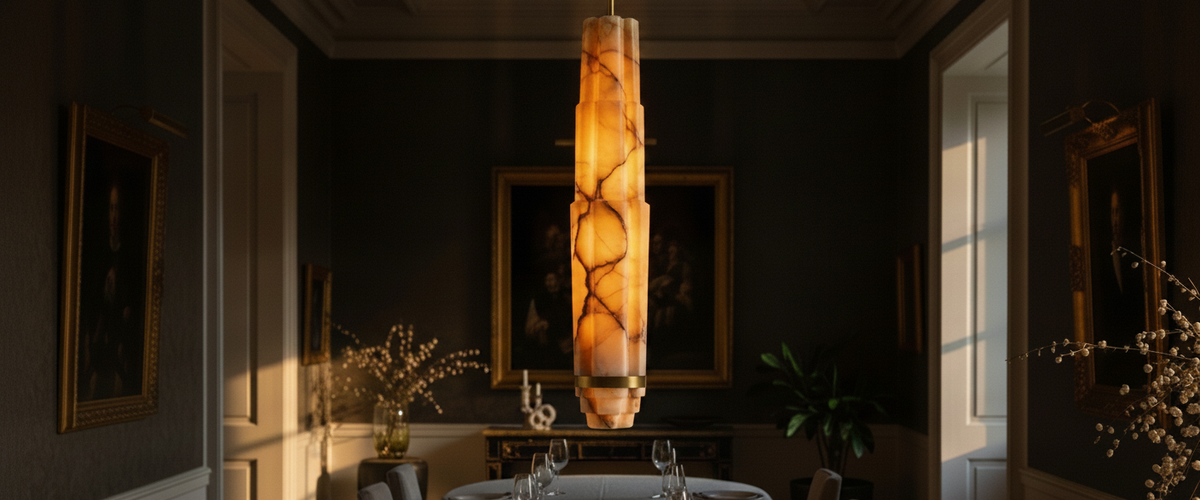

Switch on a good alabaster light and the room changes character. The stone does not just pass light through; it holds it, softens it, and pushes a warm honeyed glow back into the space. That quality is why alabaster lighting has moved from a niche specifier's choice to something interior designers ask for by name. Get it right and you have a fixture that reads as sculpture by day and a quiet source of warmth by night. Get the scale or the stone wrong and you have spent good money on something that looks thin and lit-up.
This guide is for buyers, designers, and venue owners deciding whether alabaster is the right call, and how to choose between a pendant, a ceiling light, a wall sconce, or a table lamp once they have committed.

Key Takeaways Before You Buy
Alabaster is a soft, translucent stone. It diffuses light beautifully but needs sensible care and the right bulb temperature.
No two pieces match. Veining, colour, and translucency vary slab to slab, which is the point.
Scale and bulb choice matter more than price. A correctly sized alabaster pendant on a warm dimmable LED beats a larger one running too cold or too bright.
Placement is everything. Alabaster rewards spots where you see it lit and unlit: over a dining table, beside a bed, flanking a fireplace.
Budget depends on material, scale, and engineering, not a fixed list price. Ask for a tailored quote.

What Alabaster Lighting Means and Who It Is Best For
Alabaster is a fine-grained gypsum stone that has been carved for lamps and vessels since antiquity, which tells you the material has form. According to the Encyclopaedia Britannica, true alabaster is a compact, fine-textured form of gypsum, soft enough to scratch with a fingernail and slightly translucent, which is exactly what makes it work in lighting. Because the stone is mildly translucent, a bulb set behind or inside it does not glare. The light travels through the body of the stone, picks up its internal veining, and emerges as a soft, even wash. That is the warm diffused quality you cannot fake with frosted glass or acrylic.
Alabaster lighting suits anyone who wants atmosphere rather than flat brightness. It works in homes that lean toward natural materials, in hospitality settings where lighting sets the mood, and in design projects where a fixture needs to earn its place as an object. If your priority is maximum task lighting output in a home office, alabaster is the wrong tool. If you want a room to feel calm and considered, it is hard to beat.
How to Compare Alabaster Lighting Options Before Buying
Start with the fixture type, because that decides almost everything else. An alabaster pendant light or chandelier anchors a dining table, kitchen island, or stairwell. An alabaster ceiling light or alabaster flush mount light suits hallways, bedrooms, and rooms with lower ceilings where a hanging piece would crowd the space. Alabaster wall sconce lighting layers in soft light at eye level, ideal beside a bed, along a corridor, or framing a mirror. Table and floor lamps bring the same glow down to where people sit.
Once you know the format, judge each piece on three things. First, the stone: look for genuine alabaster with visible natural veining, not resin pretending to be stone. Second, the metalwork; brushed brass and soft white finishes are common, and the join between stone and metal should feel solid, not glued-on. Third, the light engine. A modern LED-integrated linear suspension such as the Zareon LED Large Linear Alabaster Suspension Light behaves very differently from a fixture taking a single replaceable bulb, and that affects dimming, warmth, and long-term maintenance.
You can see the full spread of formats across our alabaster lighting collection, which is the quickest way to compare a stepped linear suspension against a simple flush mount before you commit. If you want to weigh alabaster against other stones first, our guide on choosing natural-stone lighting walks through how each material handles light.
Key Materials, Finishes, and Scale Decisions
Alabaster carries colour. Most pieces sit in a warm cream to honey range, with grey and amber veining running through the slab. That natural palette is why people ask whether cooler paint colours work with it. They do, with care. A light French grey reads clean and cool against the warm stone, which can be a deliberate contrast in a bedroom or a powder room; just keep the rest of the scheme warm enough that the stone does not look orphaned. If you want harmony rather than contrast, pull a tone from the stone's veining into your textiles or joinery.
Finish pairings matter too. Brushed brass warms the whole fixture and flatters the honey tones in the stone, which is why a piece like the Zareon LED Large Chevron Alabaster Suspension Light in Brushed Brass reads so warmly over a dining table. A soft white or nickel finish reads more contemporary and lets the alabaster stay the hero. Neither is better; it depends on the room's metalwork elsewhere.
Scale is where most buyers slip. A common mistake we see at the studio: a client measures the table but not the ceiling height, orders a generous pendant, then finds it hanging too low over a walkway. As a rule, for a dining pendant, leave roughly 30 to 36 inches (about 75 to 90 cm) between the tabletop and the base of the fixture, and adjust up for taller ceilings. For a linear suspension over an island, the fixture should run around two-thirds the length of the island, not the full span.
Where to Place Alabaster Lighting for the Strongest Visual Impact
Alabaster earns its keep where you experience it both lit and unlit. Over a dining table is the classic position; a stepped or chevron alabaster suspension throws a warm pool onto the table and reads as a carved object when the meal is over. In a kitchen, a long cylindrical run such as the Valenro 24 Light Cylindrical Alabaster Linear Suspension Light gives even light over an island without the hotspots a row of bare spots produces.
In bedrooms, pair flush or semi-flush ceiling fixtures with alabaster wall sconces beside the bed. The sconces give you readable, low-glare light at night, and the stone glows gently rather than blasting the ceiling. Hallways and stairwells are quietly the best place for an alabaster ceiling light, because you pass through repeatedly and the soft glow makes the transition feel considered rather than purely functional.
For wall placement specifically, a sconce works hardest flanking something: a fireplace, a headboard, a mirror, a piece of art. Mount sconces at roughly 60 to 66 inches (about 152 to 168 cm) to centre, then adjust for the room and the people using it. Browse the broader lighting range if you want to see how pendants, sconces, and lamps look layered together rather than judged in isolation.
Budget, Quality, and Delivery Considerations
There is no honest fixed price for alabaster lighting, and you should be wary of anyone who gives you one before knowing the spec. Cost is driven by the volume and grade of stone, the size of the fixture, the complexity of the metalwork, the light engine, and whether the piece is a single pendant or a multi-arm chandelier. A small wall sconce and a large 24-light linear suspension are different propositions entirely. The sensible move is to settle the format and scale first, then request a tailored quote.
On quality, the things that last are honest stone, properly engineered fittings, and a sensible light source. Because alabaster is natural, expect variation in colour and veining between pieces; that is a feature, not a fault, and a reputable supplier will tell you so up front. On delivery, treat alabaster as fragile in transit. It is heavier and more brittle than glass, so packing and handling matter, and larger pieces often need a longer lead time.
Caring for Alabaster So It Keeps Its Glow
Alabaster is softer than marble and sensitive to water, so cleaning is gentle work. To clean an alabaster light shade, switch the fixture off and let it cool, then dust with a soft dry cloth or a clean soft brush. For marks, use a barely damp cloth and dry immediately; never soak the stone or use acidic or abrasive cleaners, which can etch and dull the surface. Standard conservation practice for gypsum-based stone is to keep it dry and avoid harsh chemicals, and that holds for lamps as much as sculpture. Keep alabaster out of damp bathrooms and away from steam unless the fixture is specifically rated for it.
How Niori Can Help With Lighting Projects
Niori designs and supplies alabaster and natural-stone lighting: pendants, chandeliers, ceiling and flush mount fixtures, wall sconces, and table and floor lamps, with brass and soft white detailing chosen to flatter the stone. We work with homeowners, interior designers, architects, and venue owners on single statement pieces and full project specifications. If you are weighing up scale, finish, or how a fixture will sit in a particular room, that is exactly the conversation worth having before you order. Start from the Niori homepage to see the range, then come to us with the room and we will help you get the format and scale right.