
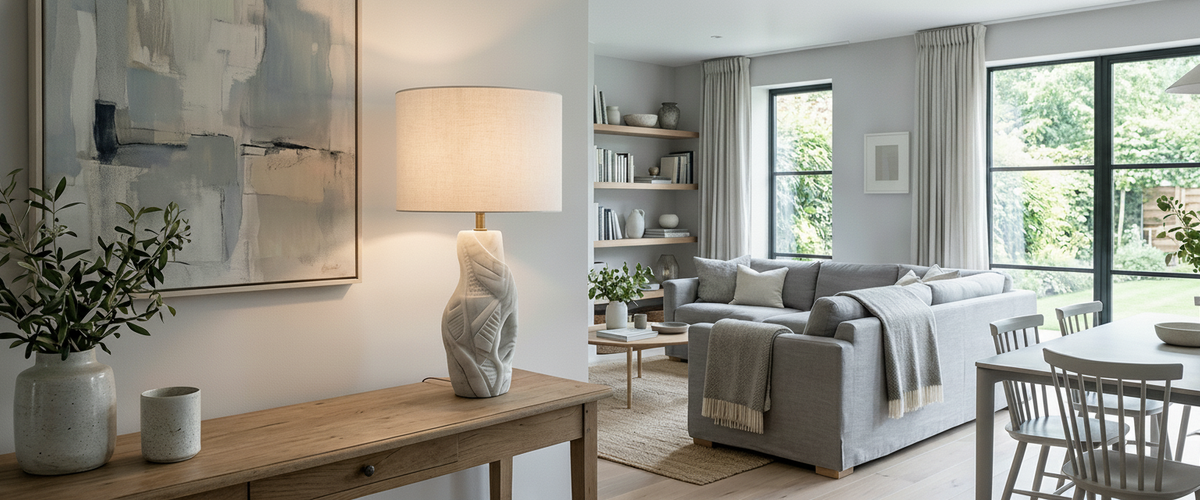

A vintage alabaster table lamp can carry more character in one piece of stone than a whole shelf of new lighting. It can also hide a cracked base, a clumsy old repair, and wiring that should never see another decade. The difference between a find and a regret usually comes down to how closely you look before you hand over money. We sell alabaster and natural-stone lighting for a living, and the lamps that come back to us with questions almost always failed the same few checks.
Looking for the full range in this category? Browse our Alabaster Lighting collection for every available finish, size, and configuration.
The depth of glow is the clearest sign you are looking at genuine aged alabaster.
Here is the short version before the detail on buying a vintage alabaster table lamp.
Genuine aged alabaster shows soft, irregular veining, warm patina, and tiny surface wear that no factory replicates cleanly.
Old wiring is the real hazard, not the stone. Budget for a rewire by a qualified electrician on any lamp more than a few decades old.
The glow test matters. Period stone diffuses light with a depth that tells you whether you are holding alabaster or a moulded stand-in.
Repairs are not deal-breakers, but undisclosed ones are. Ask, and watch how the seller answers.

How to Tell Genuine Aged Alabaster From a Modern Stand-In
Real alabaster is a form of gypsum, soft enough to carve by hand and slightly cool to the touch even in a warm room. On the Mohs hardness scale it sits at about 2, which is why it scratches with a fingernail where harder stone would not. That coolness fades faster than resin or acrylic, which holds body heat. Pick the vintage alabaster table lamp up. Stone has weight that surprises people; a typical period table lamp body can run 4 to 7 lbs (about 2 to 3 kg), while a hollow resin copy feels too light for its size and rings differently when tapped.
Look at the surface under raking light, held at an angle rather than straight on. Carved alabaster shows faint tool marks and a slightly uneven sheen where the polish has aged at different rates. A moulded modern piece tends to be uniform, with veining that repeats or sits suspiciously evenly across the form. The Victoria and Albert Museum's notes on alabaster as a sculptural material are a useful primer on why the stone behaves the way it does and why no two pieces age identically.
One quick studio trick: genuine alabaster is porous, so a tiny drop of water on a hidden underside is absorbed slowly and leaves a faint darker mark before it dries. Resin beads and wipes clean. Do this only with the seller's permission and only on a base or foot of the lamp, never on a visible carved face.

Reading the Veining, Repairs and Patina Before You Buy
Veining is the fingerprint of a stone lamp. In an antique alabaster table lamp the veins drift, fork, and change colour, from honey to grey to a cloudy white, with no logic a mould could reproduce. That randomness is the point on any aged vintage alabaster table lamp. If the pattern looks designed, be sceptical.
Irregular, drifting veins that no mould could repeat are the fingerprint of genuine aged stone.
Patina is the second tell. Decades of handling leave a soft, warm cast and a smoothing of the high points where hands have rested. It is subtle and very hard to fake convincingly. Old wax or polish can build up in the carved recesses; a slight ambering there is reassuring rather than a fault.
Repairs deserve calm, honest attention. Alabaster chips and cracks because it is soft, so an older vintage alabaster table lamp often carries history. Run a fingernail gently across suspect lines. A filled crack feels different from the surrounding stone and may fluoresce under a UV torch, since many old adhesives glow. A well-done restoration is fine. What you want to avoid is a structural crack near the base or the lamp's stem that has been disguised, because that is where the weight and the wiring meet. If you want a deeper steer on the material itself, our guide to what alabaster lighting is and how to care for it covers how the stone wears over time.
Why Old Wiring Is the Quiet Risk in Any Vintage Lamp
The stone might be flawless and the lamp still unsafe. Vintage and antique lamps frequently carry their original flex: cloth-covered cable that has gone brittle, two-core wiring with no earth, and a bulb holder that has been replaced badly more than once. This is the single most common problem we see on a vintage alabaster table lamp, and it is invisible until someone looks inside.
Treat a rewire as standard, not optional. A qualified electrician should fit new flex, a modern bulb holder, and a fused plug suited to your supply, and check the lamp meets current UK wiring standards before you live with it. The IET's guidance on electrical safety is the reference your electrician will work to. Rewiring a stone lamp is delicate because the cable usually threads through a drilled channel in the alabaster, so this is not a casual DIY job; the risk of chipping the stone or stressing a hairline crack is real.
Ask the seller directly whether the lamp has been rewired and when. If they cannot say, assume it has not, and factor the cost in. A modern alabaster table lamp from a specialist arrives wired to standard, which is part of what you pay for; a period vintage alabaster table lamp transfers that responsibility to you.
The Glow Test: How Period Stone Diffuses Light Differently
This is the part that makes a vintage alabaster table lamp worth the trouble. Switch the lamp on in a dim room. Genuine alabaster does not just glow at the surface; the light sinks 2 to 3 millimetres into the stone and the veins come alive, throwing soft amber and grey shadows that shift as you change your angle. It reads as depth, not a flat lit panel.
A resin or glass stand-in lights more evenly and more coldly. It can look pleasant, but it lacks the layered warmth that period alabaster gives off. If you have only ever seen the stone lit in photos, the difference in person is obvious within seconds.
The quality of that glow also depends on the bulb. Use a warm LED in the 2400K to 2700K range to flatter the stone's natural tones, and choose one with a colour rendering index of 90 or higher so the veining reads true. A dimmable bulb on a compatible dimmer lets you drop the light to a low, candle-like level in the evening, which is where these lamps earn their keep. The same depth of glow is now engineered into larger contemporary fittings too; where a room needs that diffused stone warmth overhead rather than at table height, a piece such as the Aurelio Large Alabaster Globe Chandelier shows how the period quality of light has been carried into modern form.
Pairing an Old Stone Lamp With a Room That Isn't a Museum
A vintage alabaster table lamp does not need a period interior to look right. The trick is contrast. Set a honey-toned antique alabaster table lamp on a clean-lined modern console and the age reads as deliberate rather than dusty. We shipped a pair of older alabaster lamps to a client furnishing a stripped-back Cotswolds barn conversion, and they sat far better against pale plaster and oak than they ever would have in a heavily traditional drawing room.
Balance the warmth. The amber glow pairs naturally with brass, aged bronze, and unlacquered metals, and it softens cooler schemes built around grey stone or steel. In a study or bedside setting, one vintage alabaster table lamp is often enough to set the whole mood. On a long sideboard, a matched pair gives symmetry that feels considered. If you are layering a period lamp with a more decorative modern accent, something like the Narbonne Table Lamp with its black wooden urn base and gold leaf detail picks up the same brass-and-warmth language without competing with the stone for attention. The broader lighting range is a useful way to see how stone reads alongside brass and glass before you commit.
Honest Red Flags to Raise With a Seller Before Committing
A good seller welcomes questions. A nervous one tells you a lot.
Vague age claims. "Old" or "vintage" with no era is fine if the price reflects it, but push for any provenance the seller has.
No mention of wiring. Always ask. Silence usually means original flex.
Cracks near the base or stem. Cosmetic chips on an edge are character; structural cracks where the lamp bears weight are a walk-away.
Veining that looks printed. Too even, too repetitive, or oddly bright under light suggests resin.
Heavy filler in recesses. Some restoration is normal; a lamp that is more filler than stone is not.
Reluctance to send extra photos. Underside, base, switch, and lit shots should be easy to provide.
Pricing on a genuine vintage alabaster table lamp varies enormously with age, condition, size, and the quality of any restoration, so treat wildly cheap listings with caution and ask for a clear breakdown of what you are paying for. Where a piece needs rewiring or repair, build that into your sums before you decide.
Niori works in alabaster and natural stone every day, and our honest take is this: buy a vintage alabaster table lamp for the character and the glow, not as a bargain. Look closely, insist on safe wiring, and judge the light with your own eyes. Get those three right and an old vintage alabaster table lamp will outlast almost everything else in the room.